


Walk into any home décor store and ask which is better, linen or cotton curtains, and you’ll get two confident, opposite answers from two different salespeople. That’s not because one of them is wrong. It’s because the question itself is incomplete.
Most buyers pick a curtain fabric based on how it looks in a showroom photo, then get frustrated six months later when it fades, sags, or lets in too much morning light. The real issue isn’t taste — it’s mismatch between fabric and room.
This article breaks down exactly how linen and cotton behave in real homes: under sunlight, in humid climates, after fifty washes, and over five years of daily use. By the end, you’ll know which fabric fits your specific room, not just which one looks nicer in a catalog.
One of these fabrics is quietly better at the one job most people forget curtains are supposed to do. We’ll get to that.
Why “Which Is Better” Is the Wrong Question to Start With
Linen and cotton aren’t competing for the same job. That’s the part most comparison articles skip.
Cotton is a short-staple fiber, tightly spun, which makes it dense, smooth, and predictable. Linen comes from the flax plant’s stalk, has longer fibers, and is naturally more textured and irregular. That single structural difference explains almost every practical difference you’ll notice later — drape, light behavior, wrinkling, and lifespan.
So instead of asking “which fabric is better,” the more useful question is: better for what, in which room, under what conditions? A linen curtain that’s perfect for a breezy living room in a mild climate can be a poor choice for a bedroom that needs to stay pitch dark until 9 a.m.
Keep that framing in mind. It’ll save you from buying based on Pinterest photos alone.
READ THIS: Sofa to Bunk Bed Space Saving Furniture: The Ultimate Guide for Small Homes
How Linen and Cotton Actually Differ at the Fiber Level
Weight and Weave
Cotton curtains typically run 130-180 GSM (grams per square meter) for standard weaves, while linen curtains often sit between 150-260 GSM depending on how tightly it’s woven. Heavier doesn’t always mean better — it means more structure, more light-blocking, and more resistance to billowing in a draft.
Texture and Drape
Cotton falls in soft, even folds. Linen falls in looser, slightly stiffer folds with visible slubs (small irregular threads) that give it a more relaxed, almost rumpled look even when freshly hung. Some people pay extra for that texture. Others find it looks unmade.
Breathability
Both are natural fibers, so both breathe far better than polyester or synthetic blends. Linen edges out cotton slightly here because flax fibers are hollow, allowing marginally better airflow — useful in warm, humid rooms.
Light Control: Which Fabric Blocks Sun Better
This is where the two fabrics genuinely diverge, and it’s the factor most buyers underweight.
Unlined cotton curtains in a mid-weight weave block roughly 20-30% of incoming light. Unlined linen, because of its looser weave and natural gaps between fibers, often blocks less — closer to 10-20% in lightweight versions. That’s a meaningful difference if you’re trying to sleep past sunrise.
Here’s a concrete example: a customer with east-facing bedroom windows switches from linen to a mid-weight cotton and reports the room stays noticeably darker until 7:30 a.m. instead of 6 a.m. That’s not a marketing claim — it’s the direct result of denser fiber packing.
If you want linen’s texture but need better light control, a lined linen curtain closes that gap almost entirely, since the lining — not the linen itself — does the blocking work.
Bedrooms vs Living Rooms
For bedrooms facing east or south, cotton (especially a tighter weave) usually wins on light control alone. For living rooms or dining spaces where some morning glow is welcome, linen’s airier feel is an asset, not a flaw.
Humidity, Climate, and Room-by-Room Fit
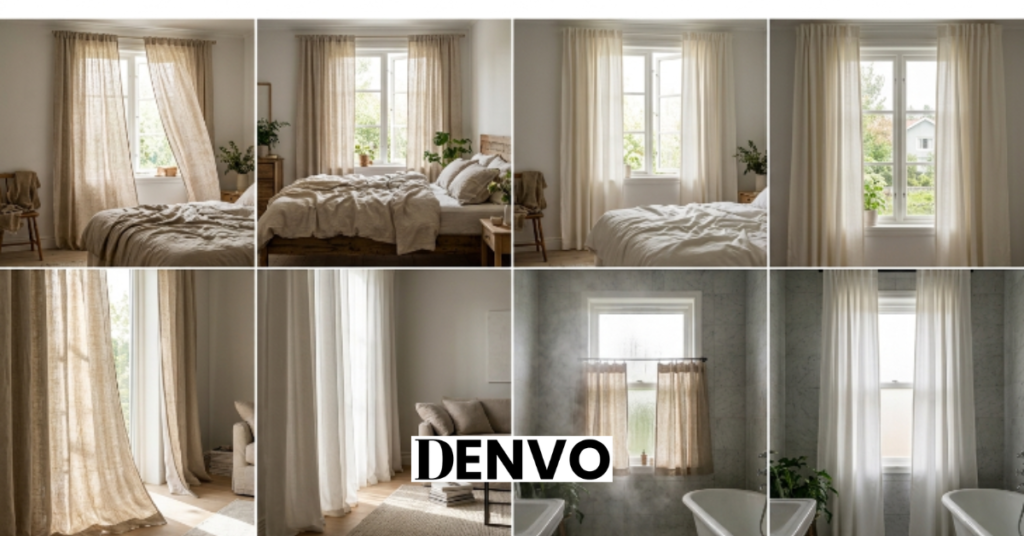
Fabric choice isn’t just aesthetic — it’s environmental.
In humid coastal climates, cotton absorbs moisture readily and can feel heavy or slightly damp-smelling if a room isn’t well-ventilated. Linen resists moisture slightly better and dries faster, which is part of why it’s traditionally popular in Mediterranean and tropical regions.
In dry, dusty climates, cotton’s tighter weave traps less dust in the folds, making it easier to keep visually clean between washes. Linen’s looser texture can hold onto dust longer, though it shakes out easily.
Bathroom or kitchen windows: Cotton generally holds up better near steam and splashes because of its tighter fiber structure.
Sunrooms or covered patios: Linen’s breathability and relaxed drape suit these more casual, airflow-heavy spaces.
Bedrooms in dry climates: Cotton again, mainly for the light-blocking advantage discussed above.
Durability and How Long Each Fabric Lasts
Contrarian take: linen has a reputation for being the “premium, long-lasting” fabric, but in direct sun exposure, that reputation doesn’t always hold up as well as people assume.
Cotton curtains, especially in mid-to-heavy weights, typically last 3-5 years with regular sun exposure before visible fading or thinning. Linen, despite being a genuinely strong fiber (flax is actually stronger than cotton at the fiber level), tends to show sun-related wear in a different way — it can become brittle and develop small tears at fold lines faster than cotton does, particularly in south-facing windows with intense, prolonged sun.
Where linen does outlast cotton is in general fiber strength and resistance to pilling. If your curtains aren’t in direct harsh sunlight, linen can genuinely last longer — sometimes 6-8 years — because the long flax fibers resist the kind of surface wear that makes cotton look tired.
So durability isn’t a flat “linen wins” or “cotton wins.” It’s sun exposure that decides the winner.
Maintenance and Care Differences
Washing
Cotton curtains tolerate machine washing well and hold their shape afterward. Linen can be machine washed too, but it wrinkles more and shrinks slightly more on the first wash (often 3-5%) if not pre-washed by the manufacturer.
Ironing
This is the one place cotton has a clear practical edge for busy households. Linen wrinkles almost immediately after washing and needs steam or ironing to look presentable. Cotton, especially blended or treated versions, holds a smoother look with far less effort.
Fading
Both fabrics fade with UV exposure over time, but cotton’s tighter dye penetration generally shows fading more gradually and evenly. Linen can fade in a slightly patchier way if the weave isn’t perfectly uniform.
READ THIS: Denvo Corner Sofa Bed: The Perfect Blend of Comfort, Style, and Functionality
Cost Over Time, Not Just at Purchase
Sticker price tells you almost nothing useful here. What matters is cost per year of use.
Say a mid-range cotton curtain panel costs $45 and lasts 4 years reliably — that’s roughly $11.25 per year. A comparable linen panel at $65 lasting 6 years in a moderate-light room comes out to about $10.80 per year. Nearly identical, once you factor in lifespan instead of just the tag price.
But move that same linen panel to a harsh, south-facing window where it only lasts 3 years instead of 6, and the math flips hard — now it’s over $21 per year, more than double the cotton option. This is exactly why the “better fabric” answer depends entirely on where the curtain is hanging, not on some universal fabric ranking.
Factor in ironing time too. If your time has value, cotton’s lower maintenance need is a real, if less obvious, cost saving over a decade of ownership.
Making the Final Call: A Simple Decision Framework
Instead of picking a side, run your specific situation through three quick filters:
1. How much light do you need blocked?
Need serious darkness (bedroom, shift worker, nursery) → lean cotton, or add a blackout lining to either fabric.
2. How much direct, harsh sun hits the window?
Intense, unfiltered south or west sun for several hours daily → cotton tends to hold up longer.
Filtered, moderate, or indirect light → linen can genuinely outlast cotton.
3. How much time do you want to spend on upkeep?
Low-maintenance preference → cotton.
Don’t mind occasional steaming for a more textured, relaxed look → linen.
Run those three questions against your actual room, and the “linen vs cotton” debate stops being abstract. It becomes a five-minute decision based on your window, your climate, and your patience for ironing.
For related decisions, see [how to measure curtains for the right length] and [understanding curtain lining types and what each one does], both of which affect this choice as much as fabric does.
Conclusion
There’s no universal winner between linen and cotton curtains — there’s only a better fit for your specific window. Cotton tends to win on light-blocking, low maintenance, and predictable dye fading. Linen tends to win on breathability, relaxed texture, and longevity in moderate light. The deciding factors are sun exposure, humidity, and how much upkeep you’re willing to do.
Before buying either fabric, check which direction your window faces and how many hours of direct sun it gets daily. That single detail will tell you more than any comparison chart. If you’re still unsure after that, consider [choosing between blackout and sheer curtain fabrics] as a next step, since lining often matters more than the base fabric itself.
FAQs
Is linen or cotton better for blocking sunlight in curtains?
Cotton generally blocks more light on its own because of its tighter, denser weave. Unlined cotton blocks roughly 20-30% of light versus 10-20% for lightweight linen. Adding a blackout lining closes this gap for either fabric.
Do linen curtains fade faster than cotton curtains in direct sunlight?
In intense, direct sun, linen can become brittle and show wear at fold lines faster than cotton, even though flax fiber is technically stronger. In moderate or filtered light, linen often outlasts cotton.
Which fabric wrinkles more, linen or cotton curtains?
Linen wrinkles noticeably more than cotton, both after washing and simply from hanging over time. Cotton holds a smoother, more consistent look with less ironing effort.
Are cotton curtains better than linen for humid or coastal climates?
Linen typically handles humidity slightly better since flax fibers are hollow and dry faster, while cotton can hold moisture longer and feel heavier in damp, poorly ventilated rooms.
Is linen more expensive than cotton for curtains long-term?
It depends on sun exposure. In moderate light, linen’s longer lifespan can make its cost-per-year close to or lower than cotton. In harsh, direct sunlight, linen wears out faster and often ends up more expensive per year than cotton.