

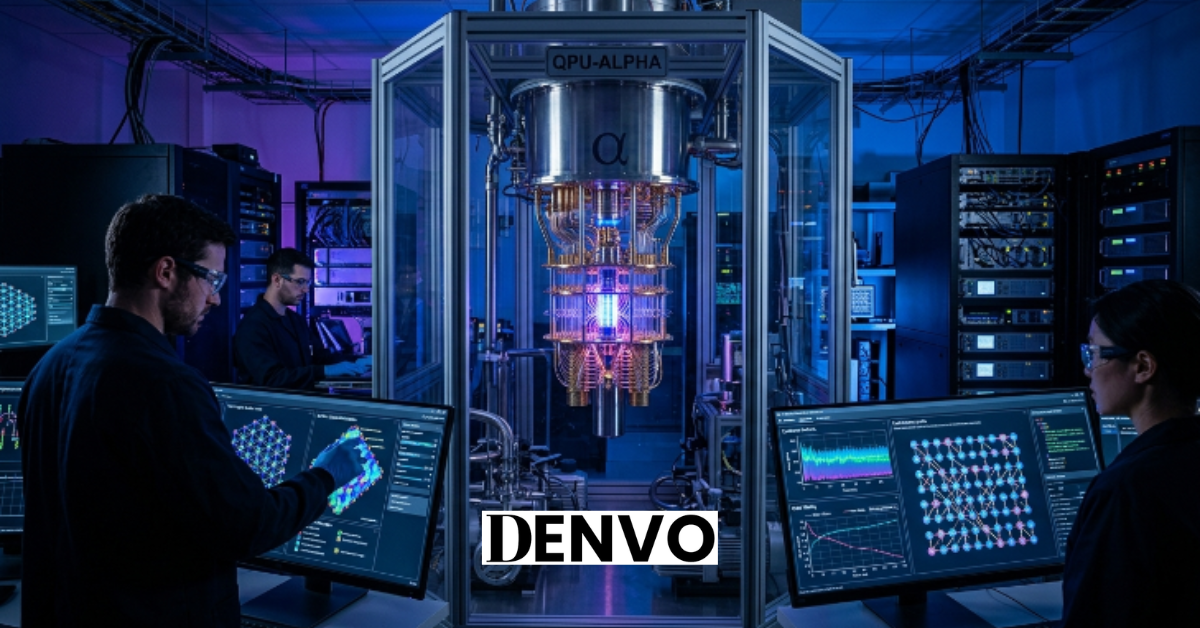
S-NISQ quantum error correction refers to error correction strategies specifically designed for Superconducting Noisy Intermediate-Scale Quantum (S-NISQ) devices — the class of quantum computers most widely used in research and early commercial applications today.
In short: These are techniques that help quantum computers produce reliable results despite the unavoidable noise and errors that occur in current-generation hardware.
Key points at a glance:
- S-NISQ devices operate with 50 to a few hundred qubits, sitting between toy quantum systems and full fault-tolerant quantum computers.
- Error correction in this regime focuses on practical mitigation — reducing errors enough to extract useful results without requiring thousands of physical qubits per logical qubit.
- As of 2026, S-NISQ quantum error correction is one of the most active research areas in quantum computing, with breakthroughs from IBM, Google, and academic institutions reshaping the field.
Introduction
Imagine building the world’s most powerful calculator, only to discover it makes random mistakes in the middle of every sum. That is essentially the challenge facing quantum computing today — and it is precisely why s-nisq quantum error correction has become such a critical area of research.
Quantum computers are extraordinary machines. They process information using the principles of quantum mechanics, allowing them to tackle problems that would take classical computers millions of years to solve. But they come with a fundamental problem: qubits — the quantum equivalent of classical bits — are extraordinarily fragile.
In this guide, you will learn what S-NISQ quantum error correction actually is, why it matters so profoundly in 2026, how it works in practice, and what the leading approaches look like. Whether you are a curious reader, a student, or a professional trying to keep pace with the quantum revolution, this article has you covered.
What Is S-NISQ Quantum Error Correction?
To understand s-nisq quantum error correction, we first need to unpack the terminology.
NISQ stands for Noisy Intermediate-Scale Quantum. The term was coined by physicist John Preskill in 2018 to describe the current generation of quantum processors — machines with tens to hundreds of qubits that are powerful enough to be interesting, but too noisy and small to run fully fault-tolerant quantum algorithms.
The ‘S’ in S-NISQ specifically refers to superconducting qubits, the dominant hardware architecture used by companies like IBM and Google. Superconducting qubits operate at temperatures close to absolute zero and manipulate quantum information using microwave pulses.
Error correction, in the quantum context, means detecting and fixing the errors that inevitably creep into quantum computations. Unlike a classical bit, which is either 0 or 1, a qubit can exist in a superposition of both states simultaneously — but this superposition is easily disrupted by its environment, a phenomenon called decoherence.
Put it all together, and s-nisq quantum error correction describes the set of methods, protocols, and algorithms used to reduce or mitigate errors in superconducting noisy intermediate-scale quantum hardware.
It is worth distinguishing this from full fault-tolerant quantum error correction, which is the long-term goal of the field. Fault-tolerant approaches use logical qubits — each composed of hundreds or thousands of physical qubits — to encode information in a way that errors can be perfectly corrected. S-NISQ error correction, by contrast, works within the constraints of today’s hardware, using techniques such as:
- Zero-noise extrapolation (ZNE) — running circuits at artificially increased noise levels and extrapolating back to zero noise.
- Probabilistic error cancellation (PEC) — representing the ideal circuit as a sum of noisy ones, then sampling to cancel errors statistically.
- Symmetry verification — checking whether quantum states obey known symmetries to detect and discard erroneous results.
- Quantum subspace expansion — post-processing results using a classical computer to improve accuracy.
A real-world analogy: think of S-NISQ error correction as noise-cancelling headphones for a quantum computer. They do not eliminate noise entirely, but they reduce it enough that the signal — the useful quantum computation — comes through clearly.
Why S-NISQ Quantum Error Correction Matters in 2026

The relevance of s-nisq quantum error correction has never been higher. In 2025 and 2026, quantum hardware has advanced dramatically — IBM’s Heron and Condor processors, Google’s Willow chip, and a wave of startups have pushed qubit counts and gate fidelities to new heights. Yet noise remains the defining constraint.
Here is why getting error correction right in this era is so consequential:
1. Unlocking real-world applications. Quantum advantage — the point at which a quantum computer outperforms classical machines on a practically useful task — requires circuit depths far beyond what raw noisy hardware can support. Error correction bridges that gap.
2. Commercial viability. Pharmaceutical companies, financial institutions, and logistics firms are investing in quantum computing for drug discovery, portfolio optimisation, and supply chain modelling. Without reliable error correction, these use cases remain theoretical.
3. Scientific discovery. Quantum simulation of molecular systems is one of the most promising near-term applications. Even small improvements in error mitigation can dramatically improve the accuracy of these simulations, accelerating discoveries in chemistry and materials science.
4. Laying the groundwork for fault tolerance. The techniques developed for S-NISQ error correction are informing the design of future fault-tolerant systems. The field is not standing still — it is building the bridge to the next era of quantum computing.
Key Features of S-NISQ Quantum Error Correction Approaches
1. Hardware-Aware Design
One of the defining features of effective s-nisq quantum error correction is that it is tailored to the specific characteristics of the hardware it runs on. Superconducting qubits have distinct noise profiles — including gate errors, readout errors, and crosstalk between neighbouring qubits. The best error correction strategies exploit detailed knowledge of these noise sources.
Crosstalk mitigation, for instance, involves carefully scheduling quantum operations to avoid simultaneous gates on adjacent qubits that could interfere with each other. This hardware-level awareness is what separates practical S-NISQ correction from purely theoretical approaches.
2. Classical-Quantum Co-processing
Modern s-nisq quantum error correction does not rely on the quantum processor alone. A classical computer works alongside the quantum hardware — in real time — to process measurement outcomes, detect error syndromes, and apply corrections. This classical-quantum co-processing is sometimes called a quantum control stack.
Low-latency classical processing is essential here. Corrections must be applied before the quantum state decoheres further, which means the classical component must operate at nanosecond timescales — a significant engineering challenge in its own right.
3. Scalable Code Structures
The most widely studied error-correcting codes in the S-NISQ context include the surface code, the heavy-hex code (used by IBM), and various topological codes. These structures are chosen because they map naturally onto the 2D connectivity of superconducting qubit arrays.
The surface code is particularly popular: it requires only nearest-neighbour interactions, has a relatively high error threshold (around 1%), and is compatible with existing superconducting hardware layouts. In 2025, Google demonstrated below-threshold operation with the surface code using its Willow processor, a landmark result.
4. Error Mitigation vs Error Correction
It is important to understand the distinction between quantum error mitigation and quantum error correction — two terms often used interchangeably but technically different. Error correction actively detects and fixes errors during a computation. Error mitigation uses post-processing and statistical techniques to reduce the impact of errors on the final result.
In the S-NISQ era, both approaches are used in combination, because full error correction requires more qubits than most current hardware can spare. This pragmatic hybrid approach is characteristic of the field in 2026.
Leading S-NISQ Quantum Error Correction Approaches Compared
Below is a comparison of the major approaches to quantum error correction relevant to today’s superconducting NISQ hardware, alongside classical and long-term alternatives.
| Approach | Qubit Range | Maturity | Advantage | Limitation |
| S-NISQ Error Correction | 50–500 | Active (2025–26) | Scales with near-term hardware | Requires careful calibration |
| Full Fault-Tolerant QEC | 1,000+ | Long-term (~2030+) | Theoretically perfect correction | Hardware demands very high |
| Classical Error Correction | N/A | Mature | Extremely reliable | Cannot run quantum algorithms |
| Probabilistic Error Mitigation | 10–100 | Early research | Low overhead | Limited scalability |
Let us look at each S-NISQ approach in more detail:
Zero-Noise Extrapolation (ZNE)
ZNE works by intentionally amplifying the noise in a quantum circuit — by stretching pulses or inserting identity gates — running the circuit multiple times at different noise levels, and then extrapolating the results back to the theoretical zero-noise limit. It is one of the most widely implemented error mitigation techniques and is available in open-source frameworks like Mitiq.
The main advantage is simplicity: ZNE requires no additional qubits and can be layered on top of existing circuits. The main limitation is that it assumes noise scales smoothly, which is not always the case for complex circuits.
Probabilistic Error Cancellation (PEC)
PEC is theoretically more powerful than ZNE but comes at a significant cost: the number of circuit samples required grows exponentially with the circuit size. In practice, this limits PEC to relatively shallow circuits. That said, for near-term applications such as variational quantum eigensolvers (VQE), it can deliver meaningful improvements in accuracy.
The Surface Code in Practice
For laboratories and companies that have sufficient qubits to spare, implementing the surface code — even in a small logical qubit — is increasingly feasible. Google’s 2025 Willow results demonstrated that logical error rates can be suppressed below physical error rates as code distance increases, crossing the threshold needed for practical error correction.
This is a watershed moment for s-nisq quantum error correction: it confirms that the theory works on real hardware, and points the way to fault-tolerant computation.
How to Choose the Right Error Correction Strategy
Not every quantum application requires the same error correction approach. Choosing the right strategy depends on several factors:
Consider your circuit depth. Shallow circuits with fewer than 100 gates can often benefit from simple ZNE or symmetry verification. Deeper circuits require more sophisticated techniques or more qubits for code-based correction.
Know your hardware. The noise profile of your specific quantum processor matters enormously. IBM’s heavy-hex architecture has different connectivity and error characteristics than Google’s sycamore layout. Always tailor your error correction to your hardware.
Balance overhead against accuracy. More powerful error correction methods generally require more resources — more qubits, more shots, more classical computation. For research and benchmarking, this overhead may be acceptable; for time-sensitive commercial applications, it may not.
Use open-source tools. Frameworks like Mitiq, Qiskit’s error mitigation modules, and Cirq all include ready-to-use implementations of the most common S-NISQ error correction and mitigation techniques. Starting with these rather than building from scratch saves significant time.
A common source of confusion is treating error mitigation and error correction as interchangeable. They are not. If you are working with fewer than 100 qubits and shallower circuits, mitigation is likely your best bet. If you have access to a larger processor and need higher-confidence results, code-based correction is worth exploring.
Common Mistakes to Avoid with S-NISQ Quantum Error Correction
Mistake 1: Assuming error mitigation scales to deep circuits. ZNE and PEC work well for shallow circuits but become impractical as circuit depth increases. Assuming these techniques will work at scale is a frequent and costly misconception.
Mistake 2: Ignoring hardware-specific noise. Applying a generic error correction strategy without profiling your specific device’s noise characteristics often produces worse results than no correction at all. Every superconducting processor has a unique noise fingerprint.
Mistake 3: Conflating logical and physical qubits. When researchers report qubit counts, they are usually referring to physical qubits. A single logical qubit — with meaningful error protection — currently requires dozens to hundreds of physical qubits. Failing to account for this overhead leads to wildly optimistic estimates of what a given processor can actually do.
Mistake 4: Neglecting classical processing latency. Real-time error correction requires ultra-low-latency classical control systems. Researchers sometimes focus exclusively on the quantum side of the stack and underestimate the engineering demands placed on the classical co-processor.
Pro Tips for Getting the Most from S-NISQ Quantum Error Correction
Tip 1: Benchmark before and after. Always run your target circuit with and without error correction to measure the actual improvement. Do not assume that adding correction automatically improves results — poorly configured correction can sometimes degrade performance.
Tip 2: Use noise tomography. Quantum process tomography and randomised benchmarking give you a detailed picture of your hardware’s error channels. This information is invaluable for tailoring your error correction strategy.
Tip 3: Monitor for correlated errors. Most error models assume errors occur independently on each qubit. In practice, correlated errors — where a single event flips multiple qubits simultaneously — are common in superconducting hardware. Your error correction strategy should account for this.
Tip 4: Stay current with the literature. S-NISQ quantum error correction is moving extraordinarily fast. New techniques and results are published monthly. Following preprint servers like arXiv (quant-ph section) and keeping an eye on announcements from IBM Research and Google Quantum AI will keep you at the cutting edge.
Tip 5: Engage with the community. The quantum computing community is unusually open and collaborative. Forums like the Quantum Computing Stack Exchange, the Unitary Fund’s Discord, and academic workshops are excellent places to discuss implementation challenges and learn from practitioners.
FAQs
What exactly is S-NISQ quantum error correction?
S-NISQ quantum error correction is the practice of detecting and reducing errors in superconducting noisy intermediate-scale quantum computers — the class of quantum hardware most prevalent in research and industry today. Unlike classical computers, which use discrete, stable bits, quantum computers use qubits that are extraordinarily sensitive to environmental disturbances. The ‘S’ in S-NISQ refers to superconducting qubits; ‘NISQ’ describes devices with 50 to a few hundred qubits that are too noisy for full fault-tolerant operation. Error correction in this context ranges from purely post-processing mitigation techniques to partial implementations of quantum error-correcting codes such as the surface code. The field sits at the frontier of both theoretical and experimental quantum computing in 2026.
How does S-NISQ quantum error correction work?
At its core, s-nisq quantum error correction works by either detecting errors as they occur and applying corrective operations, or by statistically inferring and undoing the effects of errors after the fact. Techniques like zero-noise extrapolation run circuits at multiple noise levels and extrapolate to the ideal zero-noise result. Probabilistic error cancellation uses quasi-probability decompositions to cancel errors statistically. Code-based approaches, such as the surface code, encode a single logical qubit across many physical qubits and use parity measurements to detect errors without disturbing the encoded information. All of these approaches share a common goal: making quantum computations reliable enough to extract useful results from inherently noisy hardware.
How do I choose the best S-NISQ error correction approach?
Choosing the right approach depends on your hardware, circuit depth, and accuracy requirements. For shallow circuits on small processors, error mitigation techniques like ZNE or symmetry verification are pragmatic choices with low overhead. For deeper circuits or higher-accuracy requirements, code-based error correction is more powerful but demands more physical qubits. Always profile your hardware’s specific noise characteristics before selecting a strategy, and use open-source tools like Mitiq or Qiskit’s error mitigation modules as a starting point. Avoid assuming that more complex techniques are always better — the right choice balances accuracy, resource cost, and the specific demands of your application.
What mistakes should I avoid with S-NISQ quantum error correction?
The most common mistakes include assuming error mitigation techniques scale to deep circuits (they do not), applying generic correction strategies without profiling hardware-specific noise, confusing physical qubits with logical qubits (a logical qubit requires many physical qubits), and underestimating the latency demands on classical co-processors. Another frequent error is treating published error rates as fixed — noise characteristics drift over time and vary between runs, so continuous calibration is essential. Finally, do not overlook correlated errors, which violate the independent-error assumptions underlying most standard correction codes and can significantly undermine performance if ignored.
Where can I learn more about S-NISQ quantum error correction?
The best resources for learning about s-nisq quantum error correction include IBM Quantum’s open documentation and Qiskit Textbook, Google Quantum AI’s research blog, and the arXiv preprint server (specifically the quant-ph section). The Mitiq open-source library has excellent tutorials on error mitigation specifically. For a more academic grounding, John Preskill’s lecture notes on quantum computation (freely available at Caltech) and the textbook ‘Quantum Computation and Quantum Information’ by Nielsen and Chuang are essential reading. The Unitary Fund supports accessible quantum computing education and runs community events that are particularly welcoming to newcomers.
Conclusion
S-NISQ quantum error correction stands at one of the most exciting crossroads in the history of computing. We are in an era where quantum hardware is advancing at a remarkable pace, yet the challenge of noise and decoherence remains the central obstacle between where we are today and the transformative quantum future that researchers and companies are working towards.
The key takeaways from this guide: S-NISQ error correction is tailored to today’s superconducting quantum hardware; it encompasses both error mitigation and code-based correction; the field is advancing rapidly, with 2025’s surface code results marking a genuine milestone; and choosing the right approach requires understanding your hardware, your circuit requirements, and your accuracy goals.
If this article has piqued your interest, we encourage you to explore our related guides on quantum computing fundamentals, variational quantum algorithms, and the future of fault-tolerant quantum hardware
The question is no longer whether quantum computers will be powerful enough to change the world — it is how quickly we can silence the noise.