

Quick Answer Box
To put on cufflinks, fold your French cuff so both layers align, insert the cufflink post through both buttonholes with the decorative face outward, then flip or fasten the toggle/closure on the inside of your wrist. The whole process takes under 30 seconds once you know the right technique.
Introduction
Most men who wear cufflinks for the first time end up with one sleeve twisted, one closure digging into their wrist, and a growing sense that these small metal objects are personally out to get them. Sound familiar? You’re not alone — and the problem isn’t you. It’s that nobody actually teaches this properly.
Learning how to put on cufflinks correctly is one of those small skills that separates someone who looks effortlessly polished from someone who looks like they borrowed their father’s shirt. Once you know the technique, it takes less time than tying a Windsor knot. This article breaks down every step, every cufflink type, and every mistake worth avoiding — so the next time you reach for your French cuffs, you’ll feel completely at ease.
What Cufflinks Are — And Why They Still Matter
Cufflinks aren’t just decorative. They’re a statement about intentionality.
A man who wears cufflinks chose to dress with purpose. Studies on first impressions in professional settings consistently show that small grooming details — polished shoes, fitted jacket, proper cuff finish — contribute disproportionately to perceived confidence and competence. Cufflinks sit right in that category.
The modern cufflink evolved from 17th-century ribbon ties used to fasten shirt sleeves. By the early 20th century, they had become the standard for formal menswear, and today they remain the clearest visual signal that a man takes his attire seriously. Whether you’re attending a wedding, a board meeting, or a black-tie event, cufflinks communicate that you didn’t dress in a rush.
Here’s what nobody tells you: cufflinks aren’t exclusively formal anymore. Novelty cufflinks, minimalist barrel styles, and casual silk knots have made them appropriate for business casual settings too. Knowing how to wear them opens a wider range of dressing options than most men realize.
Pro Tip: Always put on your cufflinks before your jacket. Trying to fasten them through a jacket sleeve is an exercise in frustration that ends with a wrinkled cuff and late arrival.
The Different Types of Cufflinks and How Each One Works
Not all cufflinks close the same way — and that matters when it comes to putting them on.
Bullet-back (toggle) cufflinks are the most common. A small cylindrical post sits on a swivel bar. You pass the post through your cuff holes and flip the bar 90 degrees to lock it in place. These are the most beginner-friendly style and account for the majority of cufflinks sold worldwide.
Fixed-backing cufflinks (also called “rigid” or “solid back”) have a static face on both sides and no moving parts. They’re typically thicker and require a bit more effort to thread through the cuff hole, but they stay more secure once in place. These are popular in higher-end, solid-faced designs.
Chain-link cufflinks feature two decorative faces connected by a short chain. They have a looser, more relaxed drape through the cuff and were the dominant style in Edwardian menswear. They require a slightly different insertion technique — you feed one face through from the outside, let the chain pass through the hole, and allow the second face to rest against the outer cuff.
Knot (or silk knot) cufflinks are fabric-based and don’t have a rigid post at all. They’re the most casual option and work well for business-casual contexts. Inserting them is actually the easiest of all — you simply push the knot through the hole, and the larger knot on the other side holds it in place.
How to Put On Cufflinks: A Step-by-Step Guide
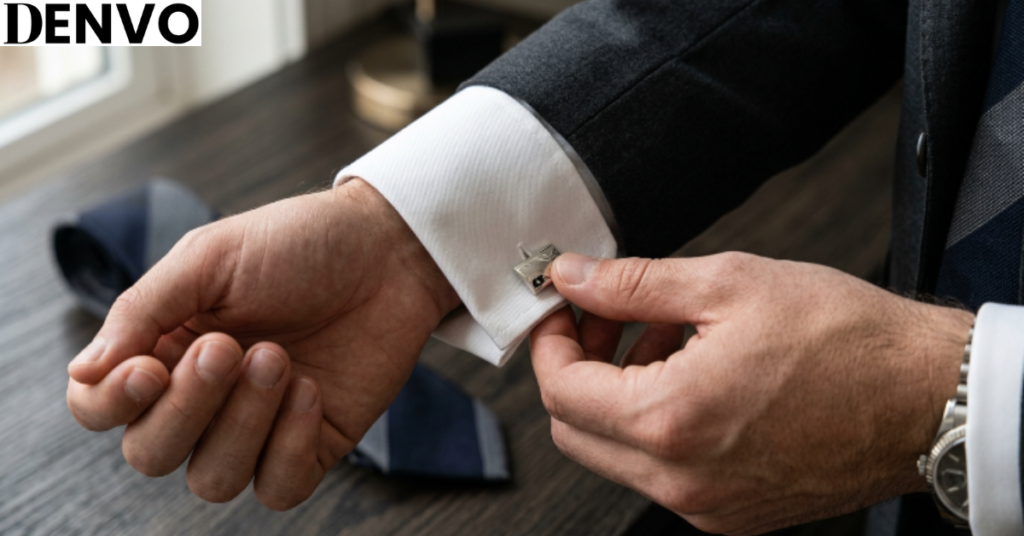
This is the core technique. Follow each step exactly and you’ll never fumble again.
Step 1: Start with the right shirt. Cufflinks require a French cuff shirt (also called a double cuff). A French cuff is longer than a standard barrel cuff — long enough to fold back on itself. If your shirt has button holes but no extra length for folding, it won’t work with traditional cufflinks.
Step 2: Put on the shirt and button it up. Leave the cuffs undone for now. Fasten every other button on the shirt first — it makes threading your arms through the sleeves easier before you seal the wrists.
Step 3: Fold the French cuff. Fold the cuff back so that both layers of fabric align perfectly. You should see two sets of buttonholes stacked directly on top of each other — four holes total (two on each layer), but you’ll be using one hole from each layer on the same side. The goal is to have the cuff sitting flat against your wrist with both layers lined up.
Step 4: Pinch and hold the cuff. Use your non-dominant hand to pinch both layers of cuff together between your thumb and index finger. This keeps the holes aligned while you insert the cufflink with your other hand. This step is where most people lose control of the cuff.
Step 5: Insert the cufflink. Hold the cufflink with the decorative face pointing outward (away from your body, visible to others). Push the post or closure end through both holes — from the outside of the cuff inward. You should feel it pass through both layers cleanly.
Step 6: Secure the closure. For toggle-back cufflinks, flip the bar 90 degrees once it’s through both holes. It should sit flat against the inside of your cuff. For fixed-back cufflinks, you’re done — the backing holds it in place. For chain-link styles, ensure the second decorative face sits flat on the outer cuff surface.
Step 7: Check the fit. The cufflink should sit snug but not dig into your wrist. The decorative face should be centered on the outer cuff, not rotated sideways. Give your wrist a gentle shake — nothing should shift.
Pro Tip: Put a small piece of tape over your cuff holes before a formal event. This keeps the holes from stretching over time and ensures a cleaner, tighter fit for your cufflinks.
Common Mistakes People Make When Wearing Cufflinks
Most people get this completely wrong: they treat the two holes in a French cuff as a single hole. A French cuff actually has four buttonholes — two on each folded layer. You only use one hole per layer (the outermost hole on each side), and they need to face each other for the cufflink to work correctly.
Wearing the decorative face on the inside of the wrist is another classic error. The face should always point outward — visible to others when your arm hangs naturally at your side or rests on a table. This seems obvious in theory, but in the fumbling rush of getting dressed, it’s easy to insert the cufflink backwards.
The third common mistake is using the wrong shirt. French cuff shirts are distinct. They’re longer at the cuff (usually about 2.5 inches of extra fabric for the fold) and have no buttons. If you’ve been trying to use a barrel cuff shirt with cufflinks, the cuff won’t fold properly, and the cufflink will look awkward and unstable.
Mismatching formality is also worth mentioning. Heavy gold cufflinks with engraving belong at black-tie events — not with a slim-cut business suit. Wearing the right style for the occasion is as important as wearing them correctly.
Cufflink Styles Compared: Which to Wear and When
| Cufflink Type | Ease of Use | Best Occasion | Formality Level |
|---|---|---|---|
| Bullet-back (toggle) | ★★★★★ | Weddings, business | Formal to semi-formal |
| Fixed back | ★★★☆☆ | Black tie, interviews | Very formal |
| Chain link | ★★★☆☆ | Weddings, receptions | Formal |
| Silk knot | ★★★★★ | Business casual | Casual to semi-formal |
| Novelty / enamel | ★★★★☆ | Casual events | Semi-casual |
Expert Tips for Looking Sharp in Cufflinks
The truth is, wearing cufflinks well is as much about proportion as technique.
Your cufflink should show about 1/2 inch (1.2 cm) beyond your jacket sleeve. This is called the “shirt break” — it’s the standard in tailored menswear and the benchmark that separates a well-dressed man from an accidental one. If your jacket sleeves are too long, even perfect cufflinks won’t be seen. Get your jacket sleeves tailored if needed.
Match your metals. If your watch has a silver case, wear silver cufflinks. If you’re wearing a gold belt buckle, go with gold cufflinks. This is a rule that professional stylists apply without exception — it creates visual coherence without any effort.
Think of it this way: cufflinks are like punctuation in a sentence. They don’t write the sentence, but they show that you finished it properly. A mismatched or oversized cufflink is like a random exclamation mark in the middle of a paragraph — it draws attention for the wrong reason.
Pro Tip: For weddings and formal events, keep a pair of classic silver or gold oval cufflinks in your wardrobe as a baseline. These go with everything and take the decision fatigue out of dressing. Novelty and personalized styles can come later once you’re confident.
Myths vs. Facts About Cufflinks
Myth: Cufflinks are only for the ultra-wealthy or ultra-formal. Fact: Silk knot cufflinks cost under $10 and are perfectly appropriate for business casual settings. You don’t need a Cartier budget to wear them well.
Myth: You need a separate shirt for every pair of cufflinks. Fact: One quality French cuff shirt works with any cufflink style. The shirt is neutral; the cufflink brings the personality.
Myth: Cufflinks are hard to put on. Fact: After the first two or three times, toggle-back cufflinks take under 20 seconds per sleeve. The learning curve is almost entirely in the first attempt.
Myth: Only older men wear cufflinks. Fact: A 2023 survey by British menswear retailer Charles Tyrwhitt found that buyers of French cuff shirts and cufflinks skewed younger than expected — with the 28–38 age bracket representing the fastest-growing segment of purchases. The “old-fashioned” association is fading rapidly.
Conclusion
Three things matter most when it comes to cufflinks: using the right shirt (French cuff, not barrel), aligning both layers of the cuff before inserting, and always wearing the decorative face outward. Get those three things right and you’re already ahead of most men who attempt them.
The rest is practice and preference. Try a pair of silk knot cufflinks if you’ve never worn them — they’re forgiving, affordable, and a low-pressure way to start. Then graduate to toggle-back, then fixed-face styles as your confidence builds.
One final thought: the men who look most effortlessly sharp in cufflinks aren’t wearing the most expensive pairs — they’re wearing the right ones, in the right setting, fastened correctly. That’s entirely learnable.
Which type of cufflink are you starting with? Drop a comment below — and if you found this guide useful, share it with someone who has a French cuff shirt gathering dust in their wardrobe.
Looking for more style guidance? Read our guide on how to match dress shoes to your suit.
FAQs
How do you put on cufflinks by yourself without help?
Putting on cufflinks solo is completely manageable with the right technique. The key is to pinch the French cuff firmly with your non-dominant hand — holding both fabric layers together between thumb and forefinger — before inserting the cufflink with your dominant hand. If you lay your arm flat on a surface (like a dresser or table) while doing this, it stabilizes the cuff and makes single-handed insertion much easier. Most people master this within two or three attempts.
What kind of shirt do you need to wear cufflinks?
Cufflinks require a French cuff shirt, also known as a double cuff shirt. These shirts have a longer sleeve cuff designed to fold back on itself, creating two layers of fabric with aligned buttonholes — and crucially, no buttons of their own. Standard barrel cuff shirts (the kind with buttons at the wrist) are not compatible with traditional cufflinks, though some shirts sold as “convertible cuffs” can accept both buttons and cufflinks.
How do you put on cufflinks when the holes won’t line up?
Misaligned holes are almost always caused by an uneven fold. Undo the cuff completely, re-fold it carefully so both layers sit flush and flat, and reattempt. If holes still seem off, check that you’re folding the cuff inward (toward the wrist) rather than outward. Some cheaper shirts have slightly off-center buttonholes — in that case, push the fabric layers together firmly with your fingers to physically force the holes into alignment before inserting the post.
How to put on cufflinks with a suit jacket on?
It’s not recommended, but if you need to: push your jacket sleeve up toward the elbow to expose the shirt cuff fully. Pinch the cuff layers together, insert the cufflink post, and secure the closure before letting the jacket sleeve fall back into place. The process is more awkward and takes longer — which is why slipping on cufflinks before the jacket is standard practice. Plan an extra 2–3 minutes if you’re doing it the other way.
What is the correct way to wear cufflinks — which side faces out?
The decorative face always points outward — away from your body, visible to others when your arm hangs naturally at your side. The closure mechanism (toggle bar, fixed back, or chain) sits against the inside of your wrist. A useful checkpoint: stand with your arms relaxed at your sides in front of a mirror. You should see the decorative face of the cufflink clearly on the outer side of each wrist. If you see the back of the toggle bar, it’s been inserted in reverse.
Can you wear cufflinks with a regular (non-French cuff) shirt?
Not with traditional cufflinks in the conventional sense. However, there are clip-on cufflinks and magnetic cufflinks specifically designed for barrel-cuff shirts — they attach to the button placket rather than threading through a hole. They don’t offer the same look as proper cufflinks, but they work as a workaround. The better long-term solution is to own at least one quality French cuff shirt:
- Choose a white or light blue option for maximum versatility.
- Ensure the cuff length allows for a clean fold.
- Look for reinforced buttonholes that won’t stretch over repeated use.
- Have it professionally pressed before formal occasions.