
Quick Answer
A red rose primarily symbolizes deep romantic love, passion, and desire. But its meaning shifts based on quantity, shade, occasion, and cultural context. One red rose says something entirely different from a dozen — and knowing that difference can change everything about how your gesture lands.
Every year, over 250 million roses are sold in the United States alone for Valentine’s Day — and most people have no idea what they’re actually saying when they hand one over.
A red rose is the most recognized symbol in human history. It crosses language barriers, cultures, and centuries. But here’s what nobody tells you: the red rose carries more meanings than most people ever learn, and getting it even slightly wrong — the wrong number, the wrong shade, the wrong context — can send a completely unintended message.
Whether you want to know what does a red rose mean before you gift one, you just received one and you’re trying to decode it, or you’re simply fascinated by the deep symbolism baked into this flower, this guide gives you the full picture. By the end, you’ll understand every layer — from ancient Rome to modern romance — and you’ll never look at a red rose the same way again.
What a Red Rose Actually Means — And Why It Matters More Than You Think
Most people stop at “red roses mean love.” That’s true, but it’s like saying “fire means warmth.” Yes — but fire also means danger, transformation, destruction, and celebration. The red rose operates the same way.
At its core, a red rose represents romantic love, deep affection, and passionate desire. It’s the flower of Aphrodite, the goddess of love in Greek mythology, and of Venus in Roman tradition. The association isn’t arbitrary — red is the color of blood, of the heart, of the body’s involuntary response to attraction. The rose’s physical beauty and its brief, fragile life mirror the intensity and urgency of love itself.
But red roses also carry meanings of respect, courage, and admiration. In Victorian times, when people couldn’t openly express emotion, the “language of flowers” — called floriography — allowed people to communicate entire sentences through carefully chosen blooms. A red rose said what words couldn’t. That layer of meaning hasn’t disappeared; it’s just become invisible to modern givers.
Pro Tip: In floriography — the Victorian language of flowers — a single red rose given upright meant “I love you.” Given upside-down, the same rose meant the exact opposite. Context has always been everything.
The Meaning Changes Completely Based on How Many You Give
Here’s what most people get completely wrong: the number of red roses in a bouquet is its own language. Giving three roses carries a radically different meaning from giving twelve. If you’re buying roses without thinking about the number, you may be saying something you didn’t intend.
| Number of Red Roses | What It Traditionally Means | Best Occasion |
|---|---|---|
| 1 (single rose) | “I love you” — love at first sight, absolute devotion | Early romance, anniversaries |
| 2 | Mutual love and affection — a connection shared equally | Couples, engagements |
| 3 | “I love you” — the classic three-word declaration | Saying those words for the first time |
| 6 | I want to be yours — infatuation, early passion | New relationships |
| 12 | Be mine — the ultimate romantic declaration | Valentine’s Day, proposals |
| 24 | You occupy my thoughts every hour of every day | Grand gestures, apologies |
| 50 | Unconditional, limitless love | Milestone anniversaries |
| 100 | Devotion — “I am completely yours” | Marriage proposals, 50th anniversaries |
| 999 | Eternal, everlasting love — a promise that never ends | Once-in-a-lifetime declarations |
Think of it this way: a single red rose is intimate, personal, intentional. A dozen is a grand statement. The number multiplies the message — which means getting it right matters.
Pro Tip: If you want to say “I love you” without spending a word, give exactly three red roses. The number itself is a direct phonetic symbol in many cultures — three syllables, three roses.
How the Shade of Red Changes Everything
Not all red roses are the same red. And the shade you choose sends its own distinct signal — whether or not you’re aware of it.
Deep Crimson Red
This is the classic. Deep crimson red signals deep, mature love — the kind that’s been tested and proven. It’s less about butterflies and more about a love that knows itself. This is the rose you give on a tenth anniversary, not a third date.
Bright Scarlet Red
Scarlet carries fire. It speaks of passion, desire, and urgent attraction. If crimson is the long-burning fireplace, scarlet is the bonfire. This shade is the one associated with new, intense romantic energy — the first rush of falling hard for someone.
Dark Burgundy Red
Burgundy red is the most complex of all. It speaks to unconscious beauty — traditionally, it means “I find you beautiful even though you don’t know it yet.” It’s the shade of unspoken feeling, of admiration from a distance. A burgundy rose from a shy admirer carries an entirely different story than a bright red dozen from a confident partner.
The truth is, most florists mix shades without thinking about this — but you now know something they probably don’t tell their customers.
Red Roses Across Cultures — It Isn’t Universal
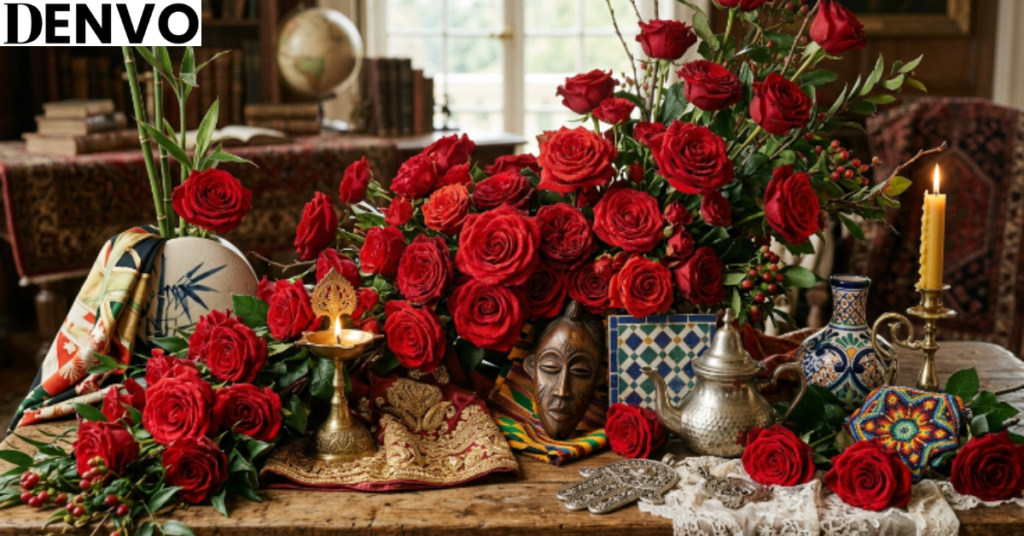
Here’s a fact that surprises most people: while the red rose is globally recognized as a romantic symbol, its specific meaning isn’t identical across every culture. Assuming it is can lead to genuine misunderstandings.
In Western cultures — Europe, North America, Australia — the red rose is almost universally tied to romantic love and Valentine’s Day. The meaning is so entrenched that it rarely needs explanation. In Chinese culture, red roses carry the same romantic meaning, but the color red itself holds additional layers of luck, prosperity, and celebration — which is why red roses appear at weddings and New Year celebrations, not only on Valentine’s Day.
In some Eastern European countries, giving an even number of flowers — including roses — is associated with mourning and funerals. An odd number is for celebrations. Knowing this before you show up with a dozen roses in Budapest or Warsaw could save you from an extremely awkward moment.
In Turkish culture, red roses carry an almost identical romantic meaning to the West — but the number matters acutely. One rose is intimate, two is for couples already committed. In Japan, roses in general signal love, but red in particular speaks to passionate, consuming affection rather than gentle fondness.
Pro Tip: When gifting red roses across cultures, always choose an odd number (except 13, which many consider unlucky in Western contexts). Odd numbers read as celebratory almost universally — it’s the safest default.
Common Mistakes People Make When Gifting Red Roses
Most people get this completely wrong — not because they don’t care, but because nobody ever explained that the details matter as much as the gesture itself.
✗ Myth / Mistake
Giving red roses to a friend as a casual “I appreciate you” — red roses are not a friendly gesture in most Western cultures. You may accidentally declare romantic feelings.
✓ Better Choice
For platonic appreciation, use yellow roses (friendship) or peach roses (gratitude). Save red specifically for romantic intent — the signal is too strong to be casual.
✗ Myth / Mistake
Assuming 12 is always the right number because it “looks full.” Twelve roses signals a very serious romantic declaration. Giving them on a second date may feel overwhelming.
✓ Better Choice
Match the number to the relationship stage. A single rose or three roses is more appropriate for early-stage romance. Twelve is for established, serious love.
✗ Myth / Mistake
Ignoring the condition of the roses. Wilting or browning petals signal neglect — the opposite of what a rose is supposed to represent.
✓ Better Choice
Always buy from a reputable florist within 24 hours of giving. A single fresh rose says far more than a dozen tired ones from a gas station.
Let me explain why this matters: the rose is a carrier of intention. When the details are off, the underlying message — however genuine — gets diluted. The flower is only as meaningful as the thought behind it.
Expert Tips: How to Give a Red Rose That Actually Lands
The most meaningful rose gift isn’t the most expensive — it’s the most considered. Here’s a step-by-step approach that elevates a simple gesture into something unforgettable.
- Choose the shade intentionally.Are you expressing deep, committed love (crimson), urgent passion (scarlet), or secret admiration (burgundy)? Pick your shade the way you’d pick your words.
- Match the number to your message.Don’t default to twelve. Think about where you are in the relationship and what you’re actually trying to say. Sometimes one perfect rose says more than twenty generic ones.
- Buy fresh, same day.A rose that was refrigerated for five days at a supermarket loses much of its sensory magic — the scent, the texture, the look. A fresh rose from a florist is worth the extra effort.
- Add a handwritten note.A red rose alone says “love.” A red rose with two lines of genuine writing says “I took time to think of you specifically.” The combination is far more powerful than either alone.
- Consider the setting.Handing someone a rose in private feels intimate. Doing it publicly signals confidence and boldness — but make sure that’s what the other person wants. The same rose, different setting, entirely different experience.
- Remove the thorns if you want to.Removing thorns traditionally signals “I have no thorns, nothing to hide — only love.” Keeping them signals natural beauty, complexity, and the understanding that love and difficulty coexist. Both are valid — just be intentional.
Pro Tip: If you want your red rose gift to outlast a week, choose a rose variety like ‘Forever Young’ or ‘Freedom’ — florists know these by name. They last significantly longer than standard cut roses and hold their color beautifully.
Myths vs. Facts: What Everyone Gets Wrong About Red Rose Symbolism
The red rose is possibly the most mythologized flower in human history. Let’s separate what’s real from what’s cultural noise.
Myth: Red roses are only for Valentine’s Day. The reality is that the red rose’s symbolism has no seasonal limit. It’s been given to express love, respect, and admiration across every month of the year for thousands of years. Limiting it to February 14th is a commercial invention, not a cultural tradition.
Myth: A wilted rose is just an unfortunate accident. In floriography tradition, a wilted or dying rose given to someone carried a specific and devastating message — it meant the relationship or feeling was fading, that love was ending. This is rarely the intent of modern givers, but the superstition persists in some cultures. Don’t risk it.
Myth: The redder the rose, the stronger the love. Not quite. As established earlier, shade carries specific meaning — darker doesn’t mean deeper in any straightforward sense. A perfectly chosen single deep-crimson rose from a 20-year marriage carries more depth than three dozen bright scarlet ones from someone who barely knows you.
Here’s what nobody tells you: the red rose’s power comes not from the flower itself, but from the human meaning we’ve layered onto it over millennia. It’s a shared language. And like any language, it rewards those who take the time to learn it properly.
FAQs
What does a red rose mean when a man gives it to a woman?
When a man gives a woman a red rose, it traditionally signals romantic interest, admiration, or deep love. The specific intensity depends on context and quantity. One rose on a first date suggests strong attraction. A dozen in an established relationship confirms devotion. In nearly all Western cultures, this gesture is understood as unambiguously romantic — unlike flowers of other colors, a red rose leaves little room for misinterpretation, which is both its power and its responsibility.
What does a single red rose mean from a guy?
A single red rose from a man is one of the most direct and intentional gestures in the floral language. It avoids the “bouquet statement” of multiple roses and instead says something more personal: “I chose this specifically for you.” Historically, one red rose means “I love you” — pure and simple. It’s minimalist but loaded with meaning, often more powerful than a larger arrangement precisely because it requires no filler to make its point.
What does a red rose mean spiritually?
Across multiple spiritual traditions, the red rose carries rich symbolism beyond romance. In Christianity, the red rose has been associated with the Virgin Mary and with Christ’s sacrifice — its red color linked to divine love and martyrdom. In Sufi Islamic poetry, the red rose represents the soul’s longing for the divine. In Rosicrucianism, the rose is a mystical symbol of spiritual unfolding and the union of opposites. The five petals of a wild rose correspond to the five wounds of Christ in Catholic symbolism. Spiritually, the red rose is almost universally a symbol of transcendent love and sacred beauty.
What does a red rose tattoo mean?
A red rose tattoo carries layered meaning depending on design choices:
- A blooming red rose = love, beauty, and life fully expressed
- A rose with thorns = the understanding that love involves pain
- A wilting or dead rose = lost love, grief, or the passage of time
- A rose with a snake = temptation, duality of good and evil
- A rose over a dagger = the balance of beauty and brutality
Red specifically intensifies the romantic and passionate reading. A black rose would signal mourning or rebellion; a red one keeps the focus on love, desire, and vitality.
What does a red rose mean in a dream?
Dream interpretations aren’t science, but recurring patterns do emerge in psychological literature. Dreaming of a red rose often signals a desire for romantic connection or an existing relationship that is top of mind. Receiving a red rose in a dream can indicate feeling loved or valued. A wilting red rose in a dream often corresponds to anxiety about a relationship. A field of red roses has been associated with overwhelming emotions or a sense of abundance in love. Carl Jung associated roses in dreams with the wholeness of the self — the integration of emotional and rational experience.
Can you give a red rose for a non-romantic reason?
Technically, yes — but it requires context to avoid misreading. In some cultures, red roses at funerals honor deep respect for the deceased. In competitive settings, red roses celebrate excellence (they’re traditionally given to Formula 1 race winners). In some theatrical and dance traditions, red roses from an audience are pure applause. Outside these specific contexts, giving a red rose to someone without a clear non-romantic frame is very likely to be read as a romantic statement. When in doubt, a different color is safer for platonic expression.
Final Thoughts
Here’s what matters most from everything above: a red rose means exactly what you make it mean — but only if you know how to use it. The number you choose, the shade you select, the context you create — these aren’t decoration around the gesture. They are the gesture.
The three things worth carrying with you: red roses signal romantic love most powerfully when given with intention; the number changes the message dramatically; and the fresh quality of the rose reflects the quality of the thought behind it. Get those three things right and you can say more with a single stem than a page of words ever could.
Now I want to hear from you — what’s the most meaningful rose you’ve ever received or given? Drop your story in the comments. And if you found this useful, the next article on what different rose colors mean has everything you need to complete your fluency in this oldest of love languages.