

Quick Answer
Flocking is the collective movement behavior displayed by groups of animals — especially birds and fish — where thousands of individuals move as one coordinated unit without a leader. It emerges from three simple rules each animal follows: stay close, avoid collisions, and match speed. No conductor needed
A murmuration of starlings can contain over one million birds — and not a single one of them is in charge. No commander, no signal, no choreographer. Just a living, shifting cloud of wings that moves with a precision that makes human crowd management look primitive. That phenomenon has a name: flocking.
If you’ve ever watched a school of fish reverse direction instantly, or seen thousands of birds twist into a ribbon across a winter sky, you’ve witnessed one of nature’s most stunning performances. But flocking isn’t just beautiful. It’s mathematically elegant, scientifically profound, and increasingly important in fields you’d never expect — from robotics and AI to urban planning and stock market analysis.
This article breaks down exactly what flocking is, the science that powers it, where it shows up beyond wildlife, and what you can learn from it. By the end, you’ll see the world around you — crowds, traffic, data — in an entirely different way.
What Is Flocking — And Why It Matters Right Now
Flocking is the emergent behavior in which a group of animals moves together in a highly coordinated pattern, without centralized control. Each individual reacts only to its immediate neighbors, yet the group behaves as though it were a single organism with a shared mind. The term most commonly applies to birds, but it also describes the synchronized movement of fish (schooling), insects (swarming), and even mammals running in herds.
Why does this matter today? Because flocking behavior has become one of the most studied phenomena in complexity science. Researchers at institutions like the Santa Fe Institute have used it as a model to understand everything from the internet’s traffic patterns to the spread of financial panics. It’s a living proof that complex, intelligent-looking behavior doesn’t require intelligence — just simple rules, repeated at scale.
Here’s what nobody tells you about flocking: it’s not a biological quirk. It’s a fundamental property of how interacting systems self-organize. Once you understand that, you start seeing flocking everywhere — in every system where individuals respond to local neighbors rather than global commands.
Pro Tip: The word “murmuration” specifically refers to starling flocks. For fish it’s “schooling,” for insects it’s “swarming,” and for mammals it’s “herding” — but they all share the same core mechanics as flocking.
The Three Rules That Explain Everything
In 1986, computer scientist Craig Reynolds created a simulation called Boids — short for “bird-oids.” His goal was to replicate flocking using artificial agents. What he discovered changed both computer science and behavioral biology: realistic, fluid flocking behavior emerges from just three simple rules.
Rule 1 — Separation
Each individual avoids crowding its closest neighbors. Think of it as a personal space bubble. If another bird gets too close, steer away. This prevents mid-air collisions in a flock of one million birds — without any bird needing to “see” the whole group.
Rule 2 — Alignment
Each individual tries to match the average direction and speed of its local neighbors. Not the whole flock — just the seven or so birds immediately around it. Studies on European starlings published in PLOS Computational Biology confirmed that birds interact with roughly six or seven neighbors regardless of flock density.
Rule 3 — Cohesion
Each individual steers toward the average position of its neighbors — staying part of the group. Combined with separation, this creates a “not too close, not too far” zone that generates the characteristic fluid ripple you see in murmurations.
These three rules — applied locally, simultaneously, by every individual — produce globally coherent, strikingly intelligent-looking movement. No bird knows the shape of the flock. No fish knows the school is turning. They just follow their local rules, and intelligence emerges from the interaction. That’s the breathtaking core of flocking.
Pro Tip: Craig Reynolds’ Boids simulation is still freely available online. Running it is one of the best ways to genuinely understand how three simple rules generate extraordinary complexity. Ten minutes with Boids will teach you more than most textbook chapters.
Flocking in Nature: Beyond Birds and Fish
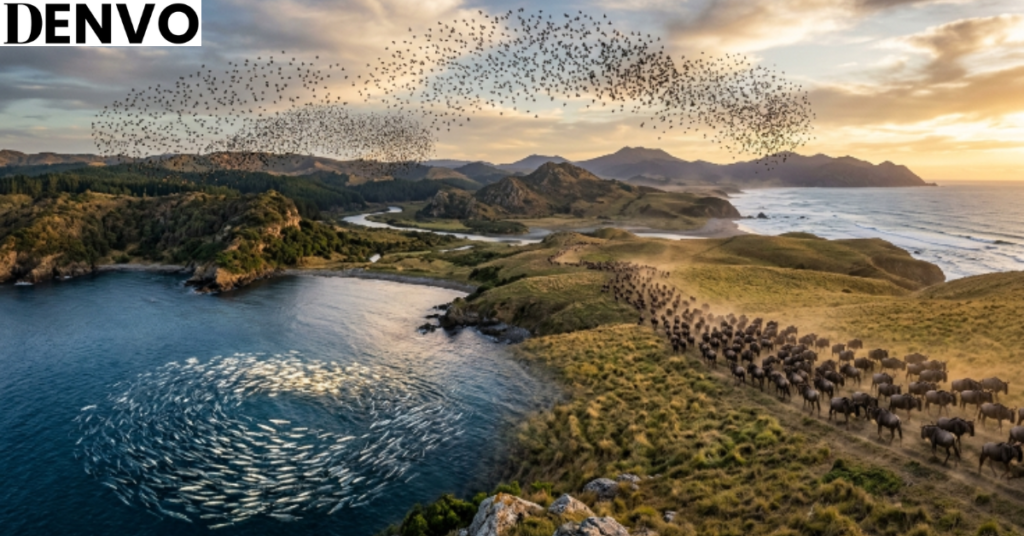
Starlings are the poster species, but flocking behavior appears across nearly every animal kingdom. Understanding the full range reveals just how universally useful this strategy is.
| Animal Group | Behavior Name | Estimated Group Size | Primary Survival Benefit |
|---|---|---|---|
| Birds (starlings) | Murmuration / Flocking | Up to 1,000,000+ | Predator confusion, warmth |
| Fish (herring) | Schooling | Millions | Dilution effect, hydrodynamic efficiency |
| Locusts | Swarming | 80 million per km² | Foraging efficiency |
| Wildebeest | Herding / Stampeding | 1.5 million (Great Migration) | Predator safety in numbers |
| Honeybees | Swarming | 10,000–20,000 | Colony relocation, queen protection |
| Fireflies (some species) | Synchronous flashing | Thousands | Mating signal amplification |
The evolutionary logic behind flocking is compelling. A predator — say, a peregrine falcon — targeting a single bird from a murmuration faces a nearly impossible task. The constant, swirling motion makes it nearly impossible to lock onto one target. This is called the confusion effect, and it’s been measured in controlled studies: predator success rates drop dramatically when prey animals flock versus moving alone.
Think of it this way: flocking evolved not because animals are smart, but because the group behavior is smarter than any individual. Nature found the algorithm first. Scientists are still catching up.
How Flocking Algorithms Changed Technology Forever
Craig Reynolds’ 1987 Boids paper didn’t just simulate birds — it quietly launched a revolution. Today, flocking algorithms are embedded in technology you use every single day, in ways most people never think about.
Video games and CGI: Every realistic crowd scene in a blockbuster film — the army of orcs in Lord of the Rings, the stampede in The Lion King remake — runs on flocking-based simulation software. Without it, you’d need to animate every individual character by hand. WETA Digital and other studios have built entire pipelines around Reynolds’ three rules.
Drone swarms: Military and civilian applications of drone swarms use flocking logic to coordinate hundreds of autonomous drones in formation without constant human input. Intel’s light show drones — which have choreographed formations of over 2,000 simultaneous drones — operate on decentralized flocking principles. Each drone knows only its position and its neighbors’. The pattern emerges from that alone.
Traffic and pedestrian modeling: Urban planners use flocking simulations to model how crowds move through buildings, stadiums, and city intersections. The 2003 Station nightclub fire and subsequent crowd crush research led to safety reforms in venue design — all informed by flocking models of human pedestrian behavior.
Pro Tip: Flocking algorithms power the “boid” particles in many popular creative coding tools like Processing and p5.js. If you’re a developer or designer, building a basic flocking simulation yourself is one of the most satisfying afternoon projects in coding — and teaches you emergence better than any lecture.
Common Misconceptions About Flocking (Most People Get These Wrong)
Flocking is widely admired but frequently misunderstood. Let’s clear up the biggest myths before they take root.
Myth #1: “There must be a leader bird”
Most people assume someone is in charge. There isn’t. Studies with GPS-tracking individual birds in a flock confirmed that no single bird consistently leads. Directional changes cascade through the group as a wave — starting from any individual, spreading outward at near-instantaneous speed. Leadership is temporary, situational, and constantly shifting.
Myth #2: “They communicate via sound or touch”
Flocking is a purely visual phenomenon for most species. Each bird responds to what it sees — the position and velocity of its neighbors. No calls, no signals, no physical contact. The speed of response is so fast (measured at under 100 milliseconds in starlings) that some researchers initially suspected electromagnetic communication. Careful study ruled that out: it’s vision, at extraordinary speed.
Myth #3: “Flocking is just random chaos”
It looks chaotic. It’s the opposite. Flocking is one of the most orderly systems in nature — it just achieves order through decentralization rather than top-down control. The fluid, apparently random shapes are actually governed by mathematical rules with measurable statistical properties. Physicists describe murmurations using the same equations used to model magnetic spin systems in condensed matter physics.
Most people get this completely wrong because they assume complexity requires a complex cause. Flocking proves otherwise: profound complexity can emerge from radical simplicity.
How to Apply Flocking Principles in Real Life
This isn’t just animal behavior trivia. The lessons of flocking translate directly into how you design teams, manage projects, and think about decentralized systems. Here’s a step-by-step approach to applying flocking logic practically.
- Define local rules, not global commands. The most resilient systems — from ant colonies to the internet — give individuals clear local rules and then get out of the way. In team management, this means investing in clear principles and values (local rules) rather than micromanaging every decision (global commands).
- Optimize for neighbor interactions. Flocking works because each bird interacts with only seven neighbors — not all million. In organizations, small cross-functional teams of 5–8 people consistently outperform large committees. This isn’t intuition; it reflects the same interaction-distance mathematics that governs flocking.
- Allow self-correction. Flocking systems absorb predator attacks, environmental turbulence, and individual errors because the response is distributed. No single point of failure. Build your systems the same way: redundancy, distributed decision-making, no single critical node.
- Trust emergence. This is the hardest one. Managers and leaders instinctively want to control outcomes. Flocking teaches you that the best outcome often emerges from structured freedom — not from control. Define the constraints. Then release.
- Iterate rapidly. Flock shapes change at 40 mph. They don’t deliberate — they respond. Build feedback loops that are fast enough to act like a flock in changing conditions. Slow feedback loops are the organizational equivalent of a bird that updates its position once per minute.
Pro Tip: Jeff Bezos’s famous “two-pizza rule” — no team should be bigger than what two pizzas can feed — is, knowingly or not, a flocking principle in corporate form. Small teams following clear rules outperform large ones following complex instructions. Reynolds figured this out about birds in 1986.
What to Avoid When Thinking About Collective Behavior
Understanding flocking also means understanding what breaks it. These are the conditions under which collective coordination collapses — in nature and in human systems alike.
Over-centralization kills emergence. If you force every decision through one node — one leader, one server, one rule — you eliminate the distributed intelligence that makes flocking powerful. The moment a single bird has to approve every direction change, the murmuration stops working. Organizations face the same dynamic constantly.
Panic and fear distort flocking behavior in animals. When a predator strikes at close range, the “confusion effect” can collapse into a stampede — everyone running in one direction, which is actually less effective than the coordinated evasion of true flocking. Human crowds behave identically. Stadium crushes happen when fear overrides distributed movement logic and produces unidirectional panic surges.
The truth is: flocking fails when the local rules break down. Too much fear, too much noise, too much hierarchy — any of these can shatter the elegant simplicity that makes the system work. The lesson isn’t just how to build these systems. It’s how fragile they are to interference.
The Takeaway
Three things to carry with you from this deep dive into flocking. First: intelligence doesn’t require a center — the most dazzling coordination in nature runs without a conductor, emerging purely from local rules applied consistently. Second: these principles aren’t locked inside biology — they power your entertainment, your city’s traffic simulations, and the next generation of autonomous machines. Third: wherever you sit — in a team, a city, a company — you are already part of a flock. The question is whether your local rules are good enough to produce something beautiful.
Now go watch a murmuration video. You’ll never see it the same way again.
What surprises you most about flocking? Drop it in the comments — or share this with someone who still thinks there’s always a bird in charge.
→ Read next: What Is Emergence? How Simple Rules Create Complex Worlds
FAQs
What is flocking behavior in animals?
Flocking behavior is the synchronized, coordinated movement of groups of animals — most visibly birds and fish — without centralized direction. Each individual follows three simple local rules (separation, alignment, cohesion) relative to nearby neighbors. The result is group-level coordination that appears intentional but emerges entirely from individual responses. It’s one of the most studied phenomena in behavioral ecology and complexity science.
What is the difference between flocking, schooling, and swarming?
These terms describe the same fundamental collective motion behavior in different animals. Flocking refers to birds, schooling to fish, and swarming to insects like bees or locusts. Some researchers use “flocking” as the umbrella term for all these phenomena since they share identical underlying rules. The distinction is largely taxonomic — the mathematics and emergent properties are remarkably consistent across species.
What are the three rules of flocking?
Computer scientist Craig Reynolds identified the three core rules in 1986. They are:
- Separation: avoid crowding immediate neighbors
- Alignment: steer toward the average heading of neighbors
- Cohesion: move toward the average position of neighbors
These rules, applied locally and simultaneously by every individual, generate the complex, fluid group dynamics observed in nature — with no leader or global coordination required.
Is there a leader in a flock of birds?
No — and this surprises most people. GPS-tagging research on real starling murmurations found no consistently leading individual. Directional changes propagate through the flock as traveling waves, originating from any bird and spreading at speeds up to 40 meters per second. “Leadership” in a flock is momentary, decentralized, and constantly redistributed. It’s one of the clearest natural demonstrations that complex coordination doesn’t require authority.
How is flocking used in artificial intelligence?
Flocking algorithms underpin several major AI and robotics fields. Particle Swarm Optimization (PSO) — a direct derivative of flocking models — is used to solve complex optimization problems in machine learning. Drone swarms use flocking logic for decentralized coordination. Game AI uses it for realistic crowd simulation. Autonomous vehicle research borrows flocking principles for multi-car platoon coordination. Reynolds’ 1986 model remains one of the most practically applied ideas in computational biology.
Why do starlings flock in murmurations?
The primary evolutionary driver is predator avoidance. Peregrine falcons, the main predators of European starlings, struggle to target individual birds within a fast-moving murmuration due to the “confusion effect” — a documented perceptual overload that dramatically reduces hunting success rates. Murmurations also serve social functions: they typically occur at dusk as birds gather before roosting, and the behavior may help individuals locate roost sites and find warm sleeping positions within large communal roosts.