
Quick Answer
Yes, the mushroom lamp trend 2026 is very much alive — but it has matured. The cheap plastic versions are out. Right now the market is driven by sculptural forms in alabaster, papier-mâché, marble, and high-gloss lacquer. The best ones work across bohemian, Japandi, mid-century, and contemporary rooms simultaneously, which is exactly why they keep selling.
Somewhere between a fairytale forest and a 1960s space-age apartment, the mushroom lamp decided it wasn’t leaving. Search interest for “mushroom lamp” peaked at a normalized score of 94 in September 2024 — and rather than fading, the trend upgraded itself. What you see dominating design fairs and interiors coverage in 2026 is not your grandmother’s plastic toadstool nightlight. It is moodier, heavier, more expensive, and considerably harder to resist.
The mushroom lamp trend 2026 marks the point where a once-quirky Pinterest obsession became a genuine design statement backed by real psychology, craft revival, and sustainability. Designers are no longer apologizing for this silhouette. They are centering entire room concepts around it.
In this article you will learn exactly why this trend refuses to die, which styles and materials actually define 2026’s version, how to avoid the most common buying mistakes, and a step-by-step guide to integrating one — or several — into your home without making it look like a theme park exhibit.
What the Mushroom Lamp Trend 2026 Really Means (And Why It Matters Now)
Most people assume this is a cute shape that went viral on TikTok. That reading is about three years out of date. The mushroom lamp trend in 2026 is better understood as the interior design world’s response to digital fatigue — a collective pivot toward organic, soft, biophilic forms after years of hard edges and sterile minimalism.
Interior designer Crystal Sinclair described it simply in an interview: mushroom lamps bring “a little magic and funk to a room.” That sounds playful, but there is real science underneath it. Research in environmental psychology consistently shows that organic, rounded shapes reduce cortisol and create a sense of safety. A lamp shaped like something that grew in a forest floor triggers the same neurological calm as seeing actual greenery. Your nervous system does not distinguish between the two.
The other reason this trend has legs in 2026 specifically: we are seeing familiar cultural echo chambers that design historians associate with ’60s revival cycles. People are reaching back to the Space Age and Art Deco eras for comfort and bold self-expression, and the mushroom silhouette — born in that exact moment of maximalist optimism — is the aesthetic beneficiary.
Pro Tip: The mushroom lamp’s power is in its duality: it reads as retro and contemporary simultaneously. If you want a piece that anchors a room without dating it to a single decade, this silhouette is one of the most reliable choices in today’s lighting market.
How the 2026 Mushroom Lamp Actually Works: Materials, Light, and Form
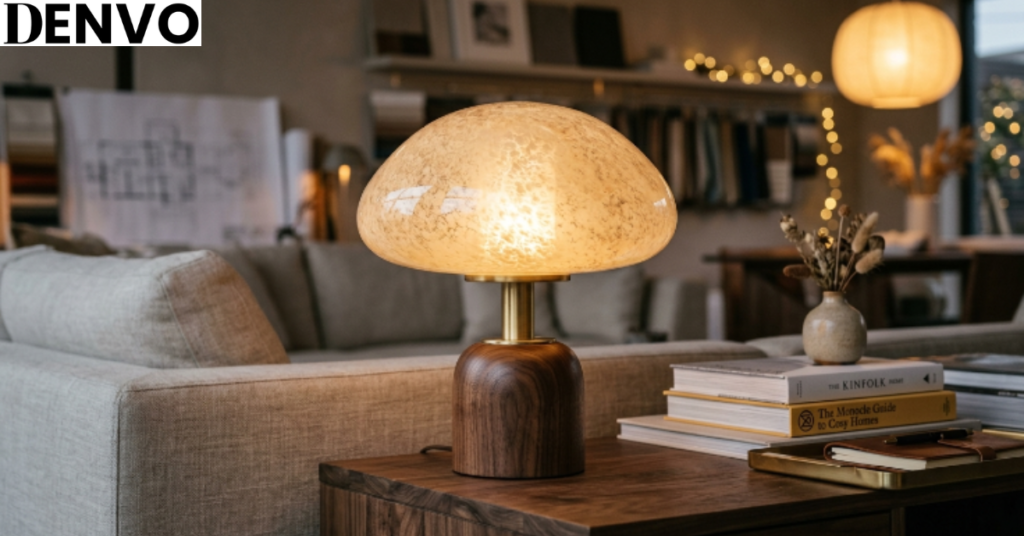
Understanding what separates a great mushroom lamp from a forgettable one comes down to three variables: material, light quality, and proportional balance. Most buyers focus only on shape and miss the other two entirely.
Materials Defining the 2026 Market
The cheap resin and plastic versions that flooded Etsy and Amazon between 2021 and 2023 are being replaced by something far more considered. Alabaster, papier-mâché, heavy glass, lacquered metal, and solid marble are the materials driving premium interest right now. Each creates a fundamentally different lighting experience.
Alabaster glows. It transmits warm light through its semi-translucent surface, creating a halo effect that no painted ceramic can replicate. Papier-mâché, as used by studios like Lume Haus, produces an almost impossibly light form that casts feathery, soft-edged shadows. Marble — as seen on Abner’s Cherry and Coral lamps spotted at India Design ID 2026 — turns the lamp into a sculptural object first, a light source second.
Light Quality: The Variable Nobody Discusses
A mushroom lamp’s cap and stem construction naturally directs light both downward and diffusely outward. This makes it ideal for ambient layering — the kind of warm, non-directional glow that interior designers use to make a room feel inhabited rather than just illuminated. Pair it with a warmer bulb (2700K–3000K) and the effect shifts from functional to atmospheric within seconds.
The proportional balance matters more than most buyers realize. A cap that is too narrow in relation to the base looks unstable visually. A cap that is too broad makes the form look heavy. The best examples get this ratio precisely right — you feel the balance before you consciously register it.
Pro Tip: When evaluating a mushroom lamp online, request a lit photo, not just a product shot. The glow quality tells you more about the lamp than any material description. Alabaster and frosted glass have a warmth that polished chrome simply cannot replicate.
Common Mistakes People Make With Mushroom Lamps (And How to Avoid Them)
Most people get this completely wrong on their first purchase. The lamp arrives, they place it on a surface, switch it on, and feel vaguely disappointed. Nine times out of ten the issue is not the lamp — it is everything surrounding the lamp.
Mistake 1: Scale Blindness
A 25 cm mushroom lamp on a large dining sideboard looks like a lost toy. A 50 cm version on a tiny bedside table looks like it is trying to eat the room. Scale is everything, and most online listings give you dimensions only if you look for them. Measure your surface before you order. As a rule: the lamp height should be roughly 1.5 to 2 times the height of the surface it sits on when viewed from seated eye level.
Mistake 2: Buying for the Photo, Not the Room
The mushroom lamps that photograph best — high-gloss coral lacquer, vivid cobalt blue — are also the hardest to integrate into an existing interior. They demand a neutral, considered backdrop to avoid visual chaos. If your room already has pattern, texture, and warm wood tones, a terracotta matte finish or a white frosted glass version will serve you far better than the Instagram-bait options.
Mistake 3: Treating It as an Isolated Purchase
A mushroom lamp reads best when it participates in a lighting layer, not when it stands alone as the room’s only light source. Place it alongside a floor lamp or overhead pendant so it functions as accent lighting rather than task lighting. The contrast between levels of light is precisely what makes the mushroom form look intentional rather than accidental.
Expert Tips and Proven Style Strategies for 2026
Here’s what nobody tells you about styling a mushroom lamp: the context you place it in does most of the aesthetic work. The same lamp can look vintage in one room and contemporary in another purely through surface material, companion objects, and surrounding color temperature.
Pairing by Interior Style
| Interior Style | Best Mushroom Lamp Material | Finish | Avoid |
|---|---|---|---|
| Japandi / Wabi-Sabi | Papier-mâché, raw ceramic | Matte, earthy tones | High-gloss chrome |
| Mid-Century Modern | Frosted glass, walnut base | Warm white or amber | Marble (too formal) |
| Maximalist / Boho | Blown glass, hand-painted ceramic | Rich jewel tones, patterns | Plain white (too quiet) |
| Contemporary Minimal | Polished chrome, alabaster | Monochrome, cool white | Kitschy plastic |
| Art Deco / Neo-Deco | Marble, brass-accented glass | High-contrast black/gold | Pastels (too soft) |
The cordless category deserves a specific mention. Rechargeable portable mushroom lamps — from brands like HAY and &Tradition — have opened up entirely new placement possibilities: dining tables, bookshelves, outdoor terraces, and bathroom counters. The freedom of no power cord changes how the object feels in a space. It becomes more like a sculpture you can reposition than a fixture you commit to.
Pro Tip: Group three mushroom lamps of slightly different heights for a botanical cluster effect on a console table or shelf. Use the same material family but vary the size. The visual result looks curated and intentional rather than purchased in a set.Internal Link Suggestion: “Cordless Table Lamps: The Complete 2026 Buying Guide”
Real-World Examples: How Designers Are Using the Mushroom Lamp Trend in 2026
The theory is useful, but nothing illustrates the possibilities better than seeing how professionals actually deploy this trend. The 2026 mushroom lamp story is being written in studios and showrooms across three continents — and the directions are fascinatingly different.
India Design ID 2026: Sculptural and Collectible
At India’s premier design fair this year, the cap-and-stem silhouette kept surfacing across multiple booths, but in an entirely elevated avatar. Studio Abner’s Cherry and Coral lamps transformed the familiar form into solid marble statements — objects that feel architectural and collectible. The intention is clear: this is a lamp you keep for decades, not a trend you replace in two years. Lume Haus took the opposite direction with featherweight papier-mâché forms that appear to bloom mid-air, casting the softest possible glow for intimate corner placements.
Nordic Design: The Portable Pioneer
Scandinavian design houses have long understood that the mushroom silhouette bridges the gap between interior object and natural form. HAY’s Pao portable lamp, Verpan’s Pantop, and Fritz Hansen’s Night Owl have all sustained commercial success not because they chased trend cycles but because they solved a functional problem beautifully — warm, flexible, wire-free ambient light in a form that suits virtually any surface.
The High-Gloss Revival: Chrome and Lacquer in 2026
Interior design specialists tracking lampshade and lamp trends in 2026 identified a significant surge in polished chrome and wet-look lacquer finishes, driven by a 1970s and ’80s nostalgia wave. A polished chrome mushroom lamp actively reflects the room around it, making spaces feel larger and more dynamic. Bold lacquer colors — cobalt blue, burnt orange, mustard yellow — are being positioned as exclamation points in otherwise neutral rooms.Internal Link Suggestion: “Biophilic Design Principles: How Natural Forms Are Reshaping Modern Interiors”
Step-by-Step Guide: How to Buy and Style a Mushroom Lamp in 2026
You have done the research. Now here is the actionable process, distilled from what interior designers actually do when sourcing and placing these lamps.
- Define your placement first. Bedside table, console, desk, or floor? The placement determines the ideal height, the appropriate brightness, and the right shade of warmth. A bedroom lamp should stay below eye level when you are in bed. A desk lamp needs more directionality. A console lamp is primarily decorative.
- Set a material budget before browsing. Mushroom lamps now range from under $30 for basic resin versions to over $800 for artisan marble pieces. Decide which tier you are in before you open any store. The mid-range ($80–$250) currently offers the best quality-to-value ratio, covering frosted glass, quality ceramic, and entry-level blown glass.
- Match the material to your room’s dominant texture. Rough plaster walls? Choose papier-mâché or raw ceramic. Polished surfaces and metal fixtures? Chrome or lacquered glass. Warm wood and natural fibers? Frosted glass or alabaster.
- Check the bulb situation. Some mushroom lamps use proprietary or unusual bulb sizes. Before purchasing, confirm what size and type the lamp requires. Lamps that accept standard E14 or E27 screws give you maximum flexibility to dial in color temperature later.
- Order a lit-state photo from the seller. For artisan or small-batch purchases especially, always ask to see the lamp switched on. The glow quality is the thing that either makes the purchase worth it or reveals a disappointing harshness the product photos hide.
- Style it with intention. Once it arrives, resist the urge to place it in the most obvious spot. Try different surfaces, different heights, different companion objects. A mushroom lamp next to a trailing plant, a small stack of books, and a textured coaster creates an entirely different narrative than the same lamp on a bare white shelf.
Pro Tip: If you find a mushroom lamp you love but the price is beyond your current budget, search for vintage versions at thrift stores, estate sales, and secondhand platforms. The 1960s and ’70s originals that inspired the current revival still turn up regularly — and at a fraction of the cost of new artisan editions.
Myths vs. Facts: What’s Actually True About the 2026 Mushroom Lamp Trend
The truth is that half of what you read about this trend in listicle content is either outdated, oversimplified, or flat-out wrong. Let’s settle the most persistent misconceptions.
Myth: “The mushroom lamp trend has peaked.”
Fact: The initial consumer craze peaked in 2023. What exists now is something more durable — a design category with genuine craft credentials, multiple material tiers, and integration into serious interior design practice. Industry forecasts project 20% year-over-year growth for eco-friendly and tech-integrated mushroom decor products into 2026, which is not the behavior of a fading trend.
Myth: “Any mushroom lamp will look the same in any room.”
Fact: The versatility of the silhouette is real, but it is not unlimited. The same cap-and-stem form in plastic feels kitsch; in blown glass, it feels artisan; in marble, it feels architectural. Material is the decisive variable that makes the same shape span wildly different aesthetic registers.
Myth: “Mushroom lamps only suit maximalist or bohemian interiors.”
Fact: In minimalist spaces, organic forms provide exactly the right contrast to clean lines. In mid-century rooms, the retro mushroom lamp silhouette reinforces the era. In Japandi-inspired spaces, the natural association of the mushroom with forest materials makes it a near-perfect fit. The idea that this lamp belongs only in eclectic or boho rooms is the most outdated assumption in this conversation.
Myth: “Mycelium and mushroom-material lamps are a gimmick.”
Fact: Studios like MushLume are producing lampshades grown from actual mushroom roots (mycelium). These are carbon-negative, biodegradable, non-toxic, and produce a glow quality that manufactured materials genuinely struggle to match. This is not a novelty category — it is an emerging segment of sustainable design with serious commercial traction in 2026.
The Bottom Line
The mushroom lamp trend 2026 is not a trend in the disposable sense of the word. It is a design archetype that has earned its place through psychological resonance, craft evolution, and genuine stylistic flexibility. The three things worth carrying away from everything above: material quality determines everything, proportional scale determines whether it reads as intentional or accidental, and the right placement context does more work than the lamp itself.
Whether you spend $40 or $400, the principles are identical. Get the material right for your room, get the scale right for your surface, and let the lamp do what this silhouette has been doing since the 1930s — make a space feel warmer, stranger, and more alive.
Which room in your home has been waiting for a light source that actually has a personality? Drop your thoughts in the comments — and if you found this useful, explore our complete guide to layered lighting for every room type.
FAQs
Are mushroom lamps still trendy in 2026?
Yes, but the nature of the trend has changed significantly. The mushroom lamp trend 2026 has moved away from mass-produced plastic versions toward artisan-crafted pieces in alabaster, marble, blown glass, and lacquered metal. The silhouette has graduated from viral novelty to genuine design category, with sustained commercial demand, representation at major international design fairs, and growing interest from serious collectors and interior designers.
What materials are best for a mushroom lamp in 2026?
The most sought-after materials in 2026 are: (1) alabaster — for a warm, luminous glow with natural veining, (2) blown glass — for artisan uniqueness and soft diffusion, (3) papier-mâché — for featherweight organic forms that cast beautiful shadows, (4) marble — for architectural weight and collectible appeal, and (5) high-gloss lacquered metal — for bold color statements in the 1970s revival aesthetic. Each produces a distinct light quality and visual character.
How do I choose the right mushroom lamp for my room?
Start with placement (bedside, console, desk, or shelf), then match material to your room’s dominant texture. Rough, natural rooms favor papier-mâché or raw ceramic. Polished, modern spaces suit chrome or lacquered glass. Warm wood-dominated interiors work best with frosted glass or alabaster. Always check the lamp dimensions against your surface and confirm the bulb type accepts standard E14 or E27 fittings for maximum flexibility in adjusting color temperature.
What is a mycelium mushroom lamp and is it worth buying?
A mycelium mushroom lamp uses lampshades or bases that are literally grown from mushroom root networks rather than manufactured in a factory. Studios like MushLume specialize in this category. These lamps are carbon-negative, fully biodegradable, non-toxic, and produce an unusually warm, organic glow that synthetic materials cannot replicate. They are worth buying if sustainability and material story matter to you — but expect higher price points and longer lead times than mass-market alternatives.
Can a mushroom lamp work in a minimalist home?
Absolutely — and arguably it works better in minimalist homes than cluttered ones. The organic, rounded silhouette provides crucial visual relief from the hard lines and flat surfaces that define minimalist interiors. The contrast between the strict geometry of minimalist furniture and the soft biomorphic lamp shape creates exactly the kind of intentional tension that makes a room feel designed rather than simply empty. Choose a monochrome alabaster or frosted white glass version to keep the form prominent without adding color complexity.
What is the mushroom lamp trend’s connection to the 1960s?
The mushroom lamp silhouette has roots in both 1930s Art Deco and 1960s Space Age design — an era defined by bold maximalism, futuristic optimism, and grand self-expression in home interiors. Design historians note that when society experiences cultural and political upheaval similar to that decade, design instinctively reaches back to the same era for inspiration. The mushroom lamp trend 2026 tracks directly to this revival cycle, as the Space Age silhouette resonates with both nostalgia and a desire for distinctive, personality-driven home objects.