


Table of Contents
The Typical Crawling Timeline, Month by Month
Signs Your Baby Is Getting Ready to Crawl
Different Crawling Styles (Not Every Baby Crawls the “Classic” Way)
What Babies Need to Develop Before They Can Crawl
What If My Baby Skips Crawling Entirely?
When to Talk to Your Pediatrician
Crawling and Baby-Proofing: What Changes Once Mobility Starts
Quick Answer
Most babies start crawling somewhere between 6 and 10 months old, with many reaching this milestone around 8 or 9 months. That said, this range is wide for a reason: crawling depends on muscle strength, coordination, motivation, and even personality, and healthy babies can hit this milestone earlier, later, or skip traditional crawling altogether and move straight to standing and walking.
If your baby isn’t crawling yet and is still within this window, there’s usually no cause for concern. What matters more than the exact week your baby starts is whether they’re steadily building strength and showing interest in moving toward things around them.
The Typical Crawling Timeline, Month by Month
Crawling isn’t a single event — it’s the result of weeks of physical groundwork. Here’s roughly how that progression tends to unfold.
Around 4 to 6 months: Babies typically develop enough neck and upper-body strength to lift their chest off the floor during tummy time and push up on their forearms. This is the foundation crawling is built on.
Around 6 to 8 months: Many babies begin rocking back and forth on their hands and knees. This rocking motion looks like practice, and in many ways it is — it helps babies learn to shift their weight, which they’ll need to actually move forward. Some babies also start scooting backward before they figure out how to move forward.
Around 7 to 10 months: This is when most babies transition into true crawling, coordinating opposite arm and leg movements to propel themselves across the floor. Some babies move quickly to this stage; others spend more time rocking and shuffling before it clicks.
Around 9 to 12 months: Many babies who crawl start pulling themselves up to stand using furniture, and some begin cruising (walking while holding onto furniture) around the same time or shortly after mastering crawling.
It’s worth repeating: these are general patterns, not deadlines. Development experts generally describe crawling as occurring anywhere in a multi-month window rather than on a fixed date, because gross motor development varies significantly between individual babies.
Signs Your Baby Is Getting Ready to Crawl
Before a baby crawls, there are usually visible clues that the necessary strength and coordination are developing. Watch for:
- Pushing up onto hands and knees and rocking back and forth
- Getting into a “downward dog” style position with hips raised
- Reaching for toys while on their belly and dragging themselves forward
- Sitting independently without support
- Bearing weight on their legs when held upright
- Showing frustration or determination when trying to reach something out of arm’s reach
These behaviors don’t guarantee crawling is imminent, but they’re a good sign that your baby’s body is preparing for it.
Different Crawling Styles (Not Every Baby Crawls the “Classic” Way)
When people picture crawling, they usually imagine the classic hands-and-knees pattern. In reality, babies use several different methods to get around, and all of them are considered normal.
Classic crawling involves moving on hands and knees with the belly lifted off the ground, alternating opposite limbs.
Commando or belly crawling involves pulling the body forward using the arms while the belly stays on the floor. Some babies use this method for weeks before transitioning to hands-and-knees crawling, and some use it as their primary mode of movement for a while.
Bear crawling looks like classic crawling but with straight legs and the bottom raised, resembling a small “downward dog” in motion.
Bottom shuffling (scooting) involves sitting upright and pushing forward using the legs and arms without ever getting onto hands and knees. Babies who bottom-shuffle sometimes walk a little later than average, but this is simply an alternative developmental path rather than a delay.
Rolling is technically a form of early mobility too. Some babies roll repeatedly across a room to reach something before they develop other crawling methods.
There isn’t a “correct” crawling style. Pediatric development guidance treats all of these as typical variations, not warning signs, as long as a baby is generally progressing in strength and mobility over time.
What Babies Need to Develop Before They Can Crawl
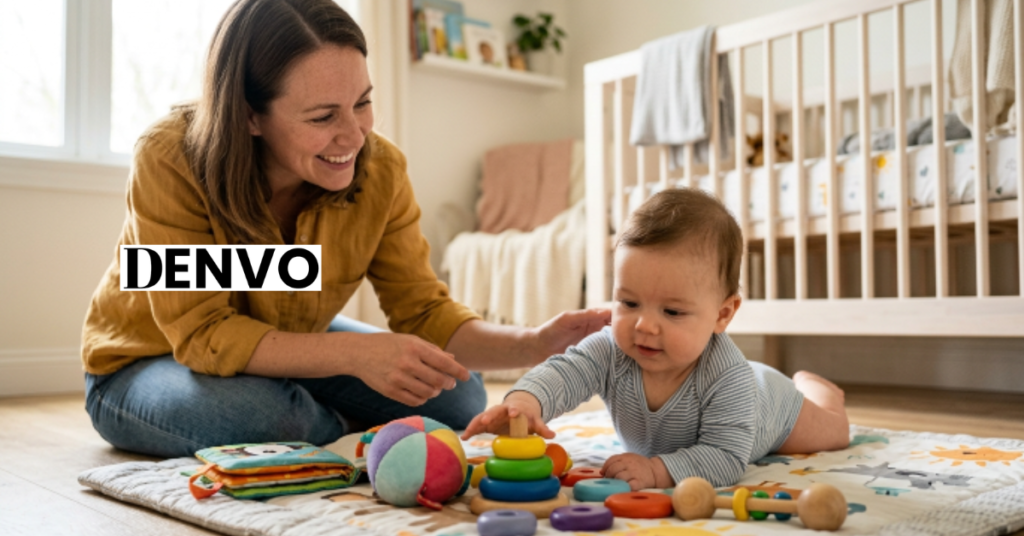
Crawling requires several physical skills to come together at once, which is part of why it doesn’t happen overnight.
Neck and head control typically develops first, usually by around 3 to 4 months, and is a prerequisite for almost every gross motor milestone that follows.
Core and back strength builds gradually through tummy time and independent sitting, and gives babies the stability needed to hold a hands-and-knees position without collapsing.
Arm and shoulder strength allows babies to bear weight on their hands rather than just their forearms, which is necessary for lifting the belly off the floor.
Weight-shifting coordination is arguably the trickiest skill. Babies need to learn how to balance on three limbs while moving the fourth, alternating this pattern on each side. This is why the rocking phase is so important — it’s essentially practice for this exact skill.
Motivation matters more than most parents expect. A baby surrounded by toys within easy reach may have less incentive to crawl than one who has to work to reach something interesting.
How to Encourage Crawling
You can’t force a baby to crawl before their body is ready, but you can create an environment that supports the process.
Prioritize tummy time daily. Tummy time builds the neck, shoulder, and core strength crawling depends on. If your baby resists it, short, frequent sessions (a few minutes at a time, several times a day) tend to work better than one long session.
Give your baby supervised floor time on a firm, flat surface. Soft surfaces like thick carpet or beds can make it harder for babies to push up and gain traction.
Place toys just out of reach. This gives babies a reason to practice reaching, rocking, and eventually moving forward, without creating frustration by placing items too far away.
Get down on the floor with your baby. Being at their eye level and encouraging them to come toward you can motivate movement more effectively than toys alone.
Avoid excessive time in containers. Bouncers, swings, and car seats are useful tools, but too much time in them limits the floor practice babies need to build crawling-related strength.
Resist comparing timelines. Baby development charts describe ranges, not competitions. A baby who crawls at 10 months isn’t behind a baby who crawled at 6 months — both are within the typical window.
What If My Baby Skips Crawling Entirely?
Skipping crawling is more common than many parents realize, and on its own, it isn’t automatically a red flag. Some babies move directly from sitting to pulling up to standing to walking, without ever crawling in a conventional sense. Others crawl only briefly before standing takes over as their preferred way to get around.
Pediatric guidance generally treats crawling as one possible path toward independent walking, not a mandatory checkpoint every baby must pass through. What matters more to a pediatrician is the overall pattern of a baby’s motor development — whether they’re gaining strength, showing increasing control over their body, and progressing toward more advanced movement over time, even if the specific sequence looks different from another child’s.
That said, if a baby shows little interest in any form of movement, has very low muscle tone, or seems to strongly favor one side of their body, these are things worth mentioning to a pediatrician, since they can sometimes point to something that benefits from an early look.
When to Talk to Your Pediatrician
Every baby develops on their own timeline, but there are specific signs that warrant a conversation with your child’s doctor rather than a wait-and-see approach. These include:
- No independent sitting by around 9 months
- No attempt at any form of self-directed movement (rolling, scooting, crawling) by around 12 months
- Noticeable asymmetry, such as using one arm or leg much more than the other
- Very stiff or very floppy muscle tone
- Little interest in reaching for objects or people
- Loss of a motor skill the baby previously had
Bringing up these concerns early doesn’t mean something is necessarily wrong. Pediatricians routinely screen for developmental milestones at well-child visits specifically so that any delays can be identified and addressed as early as possible, which tends to lead to better outcomes if support or therapy is ever needed. If you’re ever unsure, raising the question at your baby’s next checkup is always a reasonable step, rather than something to put off.
Crawling and Baby-Proofing: What Changes Once Mobility Starts
Once a baby starts crawling — or even shows strong signs they’re about to — safety needs change fast, often faster than parents expect. It’s worth baby-proofing before crawling begins rather than after, since babies tend to surprise parents with sudden bursts of mobility.
Key areas to address include securing furniture and TVs that could tip, installing outlet covers, adding gates at stairs, moving cords and blinds pulls out of reach, storing cleaning products and medications up high or in locked cabinets, and getting down on the floor yourself to see the room from a crawling baby’s perspective — you’ll often spot hazards you’d otherwise miss.
Common Myths About Crawling
Myth: Crawling is required for proper brain development. This idea circulates widely online, but there isn’t solid scientific consensus supporting the claim that crawling is essential for cognitive or neurological development. Babies who skip crawling generally show typical development overall.
Myth: Baby walkers help babies crawl and walk sooner. Pediatric organizations, including the American Academy of Pediatrics, have raised safety concerns about baby walkers and note they can actually interfere with natural motor development rather than accelerate it, in addition to posing fall and injury risks.
Myth: Late crawling means low intelligence. The age a baby crawls has no established connection to intelligence. Motor milestones and cognitive milestones develop along largely separate tracks.
Myth: Every baby crawls before walking. As covered above, a meaningful number of babies walk without ever crawling in the traditional sense.
FAQ
What is the average age babies start crawling?
Most babies begin crawling somewhere between 6 and 10 months, with many starting around 8 or 9 months. This is a broad average, and healthy babies commonly fall outside it in either direction.
Is it normal for a baby not to crawl by 9 months?
Yes. Nine months is well within the typical range, and many babies haven’t started crawling at that age. Continue watching for other developmental signs, such as sitting independently and bearing weight on the legs.
Do all babies crawl before they walk?
No. A notable number of babies skip crawling entirely and move from sitting or scooting directly to standing and walking. This is considered a normal variation, not a delay.
Can I encourage my baby to crawl faster?
You can support the process through daily tummy time, supervised floor play, and placing toys slightly out of reach, but you can’t speed up a baby’s underlying strength and coordination development beyond their own pace.
Is belly crawling (commando crawling) normal?
Yes. Belly crawling is a common and normal stage or style of movement. Some babies use it briefly before hands-and-knees crawling, while others use it as their main mode of movement for longer.
Should I be worried if my baby only crawls backward at first?
No. Moving backward before forward is common and usually just reflects which muscles are strongest first. Forward movement typically follows within a few weeks as coordination improves.
Do walkers help babies learn to crawl or walk?
Pediatric safety guidance generally recommends against baby walkers, both because of fall risks and because they don’t reliably speed up motor development, and may even interfere with a baby’s natural process of building the muscles needed to walk independently.
When should I start baby-proofing for crawling?
It’s best to baby-proof key hazards, like stairs, outlets, and unstable furniture, before your baby starts crawling, since mobility often develops faster than parents anticipate once it begins.
Conclusion
Crawling is one of the more exciting milestones in a baby’s first year, but it’s also one of the most variable. Somewhere between 6 and 10 months is typical, the exact style a baby uses can differ widely, and a fair number of babies skip crawling altogether without any underlying issue. What matters most isn’t hitting a specific date — it’s steady progress: growing strength, increasing coordination, and a baby who’s engaged with the world around them.
If your baby is meeting other developmental markers, like sitting independently and bearing weight on their legs, there’s usually little reason for concern even if crawling itself is running late. And if something feels off, or your baby isn’t showing any interest in movement by their first birthday, your pediatrician is the right person to talk to. Early conversations, even when nothing turns out to be wrong, are always worth having.