
INTRODUCTION
You’re halfway through a recipe, the bottle says “1 liter of broth,” but your measuring tools only show cups. Sound familiar?
You’re not alone — liquid measurement mix-ups are one of the most common kitchen headaches, especially when recipes from different countries use different systems.
So, how many cups in a liter? The short answer: it depends on which “cup” you’re using, but for most US recipes, 1 liter equals about 4.2 cups.
In this guide, you’ll get the exact numbers, a handy conversion chart, and simple tricks to convert liters to cups without doing math mid-recipe. By the end, you’ll never second-guess a liquid measurement again.
What Is a Liter? A Quick Refresher on Liquid Measurement
Before we answer how many cups in a liter, let’s get clear on what a liter actually is.
A liter (L) is a unit of volume in the metric system, used by most countries outside the United States. It’s the standard measurement you’ll see on:
- Bottled water and soda bottles
- Milk and juice cartons (in many countries)
- Cooking oil bottles
- Recipe books written outside the US
One liter equals 1,000 milliliters (mL), which makes it easy to scale up or down in metric recipes. For comparison, a standard water bottle is usually 500 mL, or half a liter.
The reason liter-to-cup conversions trip people up is simple: the cup is not a fixed, universal unit the way the liter is. A “cup” can mean slightly different things depending on where you live and what you’re measuring.
Here’s a quick comparison to set the stage:
| Unit | System | Common Use |
|---|---|---|
| Liter | Metric | Most countries worldwide |
| US Cup | US Customary | United States recipes |
| Metric Cup | Metric (informal) | Australia, UK, NZ recipes |
| Imperial Cup | Imperial | Older UK recipes (rare today) |
Understanding this difference is the key to getting an accurate liter to cups conversion every single time — which is exactly what we’ll break down next.
How Many Cups in a Liter? The Exact Answer
Here’s the part you came for. The exact conversion changes slightly depending on which cup measurement you’re using:
- US customary cup: 1 liter = 4.227 cups (rounded to 4.2 cups)
- US legal cup (used on US nutrition labels): 1 liter = 4.167 cups
- Metric cup (250 mL, common in Australia & UK recipes): 1 liter = exactly 4 cups
- Imperial cup (older UK standard): 1 liter = 3.5 cups
For everyday cooking and baking in the US, the number you’ll use most is 4.2 cups per liter. If a recipe is from Australia or the UK and uses “cups” as a metric measurement, you can safely round to 4 cups per liter — much simpler math.
Real example: Let’s say a soup recipe calls for 1.5 liters of vegetable stock, and you only have a US measuring cup.
- 1.5 liters × 4.2 cups = 6.3 cups of stock
That’s it. No guesswork, no spilled broth trying to “eyeball” it.
Pro tip: When a recipe doesn’t specify which cup system it’s using, check the recipe’s country of origin. US blogs and cookbooks almost always mean the US customary cup, while Australian and British sites typically mean the metric cup.
This single distinction is the #1 reason people get liter-to-cup conversions wrong — so keep it in mind every time you convert.
Liter to Cups Conversion Chart (Quick Reference)
Sometimes you just need the numbers fast — no explanations, no math. Bookmark this chart for next time you’re converting liters to cups mid-recipe.
| Liters | US Cups (approx.) | Metric Cups (250 mL) |
|---|---|---|
| 0.25 L | 1.05 cups | 1 cup |
| 0.5 L | 2.1 cups | 2 cups |
| 0.75 L | 3.2 cups | 3 cups |
| 1 L | 4.2 cups | 4 cups |
| 1.5 L | 6.3 cups | 6 cups |
| 2 L | 8.5 cups | 8 cups |
| 3 L | 12.7 cups | 12 cups |
How to use this chart:
- Find your liter measurement in the left column.
- Match it to the cup system your recipe uses (US or metric).
- Round to the nearest quarter cup if your measuring tools don’t have decimals.
This chart is especially useful for:
- Meal prepping large batches of soup, sauce, or smoothies
- Baking recipes imported from international food blogs
- Brewing coffee or tea in bulk
- Converting bottled liquids (oil, milk, juice) into recipe-friendly measurements
Save or screenshot this table — it’ll save you more time than any mental math trick.
Why Cup Measurements Vary: US vs UK vs Metric Cups Explained
This is the part most articles skip, but it’s the reason your conversions sometimes feel “off.”
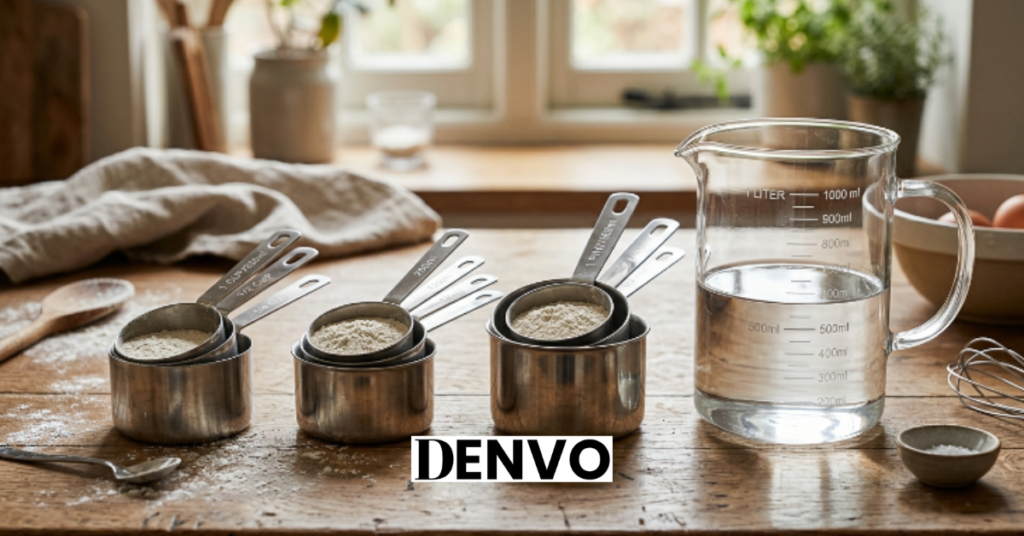
The US customary cup is based on older English units and equals 236.6 mL. It’s the cup size built into every standard US measuring cup set.
The metric cup, used in Australia, New Zealand, and increasingly in the UK, is a much rounder number: exactly 250 mL. This is why 1 liter = 4 metric cups is such a clean, easy number to remember.
The imperial cup, historically used in the UK, equals 284.1 mL — noticeably bigger than both the US and metric cup. It’s largely outdated now, but you may still see it in older British cookbooks.
Here’s why this matters in practice:
- If you use a US cup for a recipe that means metric cups, you’ll under-measure your liquid by about 6%.
- If you use a metric cup for a recipe that means US cups, you’ll over-measure slightly.
For most everyday cooking, a 6% difference won’t ruin your dish. But for baking, where ratios matter more precisely, this small gap can affect texture — think slightly drier cookies or denser cake batter.
Bottom line: When precision matters (baking, cocktails, canning), check which cup system the recipe uses before converting from liters. When precision doesn’t matter much (soups, smoothies, sauces), any reasonable rounding works fine.
Practical Tips for Converting Liters to Cups in Real Cooking
Knowing the numbers is great — but here’s how to actually use them in your kitchen without slowing down.
1. Use a liquid measuring cup with both metric and US markings. Most modern glass measuring cups show mL and cup markings side by side, so you skip the math entirely.
2. Round smartly when small differences won’t matter. For soups, stews, or smoothies, rounding 1 liter to “about 4 cups” is perfectly fine.
3. Keep a conversion chart on your fridge or phone. A simple printed or saved chart (like the one above) beats recalculating every time.
4. Use a kitchen scale for the most accurate results. Weighing liquids in grams (1 mL of water ≈ 1 gram) is often more precise than measuring by volume, especially for baking.
5. Double-check the recipe’s origin before converting. A two-second check of whether a recipe is American, British, or Australian will tell you exactly which “cup” to use.
Real-world example: A home baker following a UK recipe calling for “1 liter of milk” measured it using US cups instead of metric cups, ending up with slightly less liquid than intended. The result? A denser bread loaf. After switching to a dual-marked measuring jug, the same recipe came out perfectly — proving that small conversion mistakes can have real results in your final dish.
CONCLUSION
So, how many cups in a liter? If you remember just one number, make it this: 1 liter equals about 4.2 US cups, or exactly 4 metric cups.
The key to nailing this conversion every time is knowing which cup system your recipe is using — US, metric, or imperial — and using the chart above as your quick reference.
Whether you’re meal prepping, baking, or following an international recipe, you now have everything you need to convert liters to cups confidently and accurately.
Bookmark this guide, save the chart, and you’ll never have to second-guess a liquid measurement in your kitchen again.
FAQ SECTION
How many cups in a liter of water?
A liter of water converts the same way as any other liquid: 1 liter = 4.2 US cups, or 4 metric cups (250 mL each). Water doesn’t change the conversion because liquid volume measurements work the same regardless of the liquid’s density for everyday cooking purposes. This makes it one of the easiest conversions to remember, since water is often the reference point for measuring cups in the first place. If you’re filling a water bottle or pitcher and want it to hold roughly a liter, four cups of water is your safest estimate using a standard US measuring cup.
How many cups are in 2 liters?
Using the standard US customary cup, 2 liters equals approximately 8.5 cups. If you’re working with a metric cup (250 mL), 2 liters comes out to an even 8 cups. This conversion is especially useful for large-batch cooking, like making a big pot of soup, brewing iced tea, or prepping a large pitcher of lemonade. For quick mental math, just double the “1 liter = 4 cups” rule, then add a small buffer if you’re using US cups specifically, since they’re slightly smaller than metric cups.
Is 1 liter the same as 4 cups?
It depends on which cup you’re using. 1 liter equals exactly 4 metric cups (each 250 mL), which is why this is such a commonly quoted number online. However, using the US customary cup, 1 liter is actually closer to 4.2 cups, not exactly 4. So while “1 liter equals 4 cups” is a handy rounded estimate, it’s only precisely accurate when you’re using metric cup measurements, common in Australian and UK recipes.
How do I convert liters to cups without a calculator?
The easiest mental shortcut is this: multiply the number of liters by 4 for a quick metric-cup estimate, or by 4.2 for a more precise US-cup estimate. For example, 3 liters becomes roughly 12 to 12.7 cups depending on the system. If exact precision isn’t critical — like for soups or smoothies — rounding to whole or half cups works perfectly fine. Keeping a printed conversion chart (like the one in this guide) on your fridge is the fastest way to skip math entirely while cooking.
Why do US and UK recipes measure cups differently?
The difference comes from historical measurement systems. The US uses its own customary cup (236.6 mL), based on older English units, while the UK and Australia largely shifted to a metric cup (250 mL) when those countries adopted the metric system more broadly. This means a recipe written in the UK or Australia using “cups” is almost always referring to the metric cup, not the US one. Always check a recipe’s origin if you’re unsure which system applies, especially for baking where precision matters most.
What’s the easiest way to measure a liter without a liter container?
If you don’t have a liter-marked container, use a US measuring cup and add 4 cups plus about 3 tablespoons to reach roughly 1 liter (since 1 liter = 4.2 cups, and 0.2 cups ≈ 3 tablespoons). Alternatively, a kitchen scale makes this even easier: 1 liter of water weighs almost exactly 1,000 grams (1 kg), so weighing your liquid is often more accurate than estimating with cups. This trick works especially well for water-based liquids like broth, milk, or juice.